
Storm & Hurricane Damage
After a storm we move fast: emergency dry-in to stop the water, a documented inspection, and honest help through your insurance claim - from a local crew that will still be here for the warranty.
On the Gulf Coast, storm season isn't hypothetical. Hurricanes, tropical squalls, and everyday summer thunderstorms drive rain sideways, peel back shingles, lift flashing, and fling branches and debris across roofs from the barrier islands to the inland communities. When your roof takes a hit, two things matter more than anything else: stopping the water immediately before it ruins what's underneath, and documenting the damage properly so your insurance claim is fair, honest, and fast. We do both, in that order, and we do them the right way.
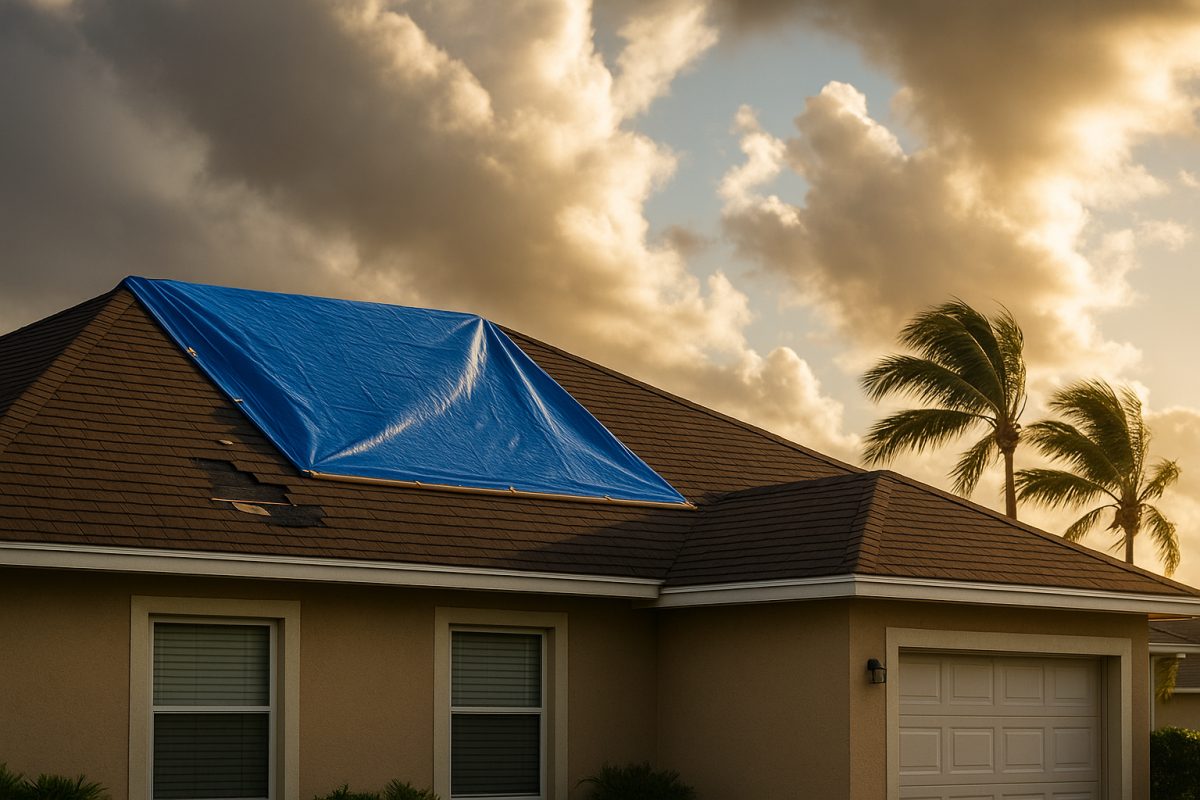
The urgency is real. Once a roof is breached, water doesn't wait for an adjuster - it soaks into decking, runs down rafters, saturates insulation, stains ceilings, and gets into walls and belongings, and every hour it keeps coming in makes the eventual repair bigger and the mess worse. That's why our first move is always to get you dried in: a secured emergency tarp or a temporary patch, properly fastened so the next afternoon storm doesn't peel it off, that stops the water now while the claim and the permanent repair get sorted out. A fast, solid dry-in often saves a homeowner far more than it costs, because it stops a roof problem from becoming a whole-house problem.
Once you're dried in, the next job is to actually find out what the storm did - and that takes more than a glance from the driveway. Storm damage is frequently invisible from the ground. Shingles can be bruised or fractured by wind and hail in ways you can't see from below; tabs can be lifted and resealed by the wind just enough to let water creep under; flashing can be displaced a fraction of an inch at a wall or chimney; granules can be scoured off, quietly shortening a shingle's remaining life. A roof that "looks fine" from the yard can have real, claimable damage that will show up as a leak months later, long after the window to file has closed. That's why we get on the roof and inspect it thoroughly and up close, with photos of everything we find.
From there it becomes a documentation job as much as a roofing one. Insurance claims are won and lost on evidence, so we photograph every affected area, note the date and nature of the storm, and put together a clear written report an adjuster can actually work from. We document honestly - we don't inflate damage, we don't manufacture it, and we don't talk anyone into a claim they don't really have. That honesty isn't just principle; it's what protects you, because a padded or fabricated claim is exactly the kind that gets denied, dragged out, or turned back on the homeowner.
And through all of it, one thing sets us apart from the crowd that descends after every big storm: we are not a storm-chasing outfit that shows up after a hurricane, signs up a street, cashes the checks, and vanishes. We live and work on this coast year-round, our name is on the work, we're licensed and insured in Florida, and we'll be here when the warranty matters - which, with a roof, is exactly when you'll need someone to stand behind it. That matters most in the weeks after a storm, when a lot of out-of-town operators are knocking on doors making promises they won't be around to keep.
How we help after a storm
- Fast emergency dry-in - a secured tarp or patch, fastened to hold, to stop water damage now
- A thorough, up-close, fully photographed inspection that catches damage the ground can't see
- A clear written report documenting every affected area, dated to the storm that caused it
- Honest documentation for your claim - no inflated, padded, or manufactured damage
- Straight talk on whether the damage is a targeted repair or a full replacement
- Help understanding your policy and coordinating with your adjuster
- Plain warnings about storm-chaser and "we'll cover your deductible" offers
- Permanent repair or replacement by a local, licensed crew that stands behind the work
Emergency dry-in: stopping the water first
When water is actively coming into your home, nothing else matters until it stops - not the claim, not the color of the new shingles, not the estimate. So that's where we start. An emergency dry-in is a secured tarp or a temporary patch, installed correctly and fastened down so it actually stays put, that seals the breach and keeps the weather out while the rest of the process plays out. Done right, it holds through the next round of afternoon thunderstorms instead of flapping loose the first time the wind picks up.
A proper dry-in is worth more than it looks. Left open, a breached roof lets water keep saturating decking, insulation, and drywall, spreading a localized roof problem into a whole-house one - soaked ceilings, ruined insulation, warped floors, and the kind of trapped moisture that leads to mold. Getting dried in fast is almost always the single most cost-effective thing you can do after storm damage, and it buys you the time to document the claim and schedule the permanent repair without watching the damage grow every time it rains.
The inspection: finding damage the ground can't see
The most important thing to understand about storm damage is that a lot of it doesn't show from the driveway. Wind and hail can bruise or fracture shingles in ways that are invisible from below but have already broken the seal that keeps water out. The wind can lift a tab and lay it back down looking normal, leaving a path for wind-driven rain. Flashing at a wall, chimney, or skylight can shift just enough to open a gap. Granules can be stripped off, aging a shingle years in a single afternoon. None of that reads as "damage" from the yard, and a homeowner who assumes the roof is fine because it looks fine can miss a legitimate claim entirely.
That's why we get on the roof and go over it up close, methodically, checking the exact spots that fail in our climate - the pipe boots, the valley metal, the ridge caps, the flashing behind the chimney, the field of the roof where hail leaves its bruises. We photograph everything, damaged or not, so there's a clear record of the roof's real condition. The goal is a complete, honest picture of what the storm actually did, so nothing real gets missed and nothing gets invented - the kind of inspection you and your adjuster can both trust.
Documenting the claim the right way
Insurance claims live and die on documentation. We photograph everything, note the date and nature of the storm that caused it, and write a clear report of what we find - the kind of dated, detailed evidence that helps an adjuster approve the work that's actually needed without a fight. The photos matter because they establish that the damage is sudden and storm-caused rather than the slow result of age, and the timing matters because linking the damage to a specific storm is often what separates a covered claim from a denied one.
What we won't do is inflate damage or manufacture it. There's a temptation - encouraged by some of the crews that swarm in after a storm - to exaggerate what happened, add damage that wasn't there, or turn a repair into a full replacement to run up the claim. That's not just dishonest; it's bad for you. Padded and fabricated claims are exactly the ones insurers scrutinize, deny, and drag out, and knowingly going along with one can leave the homeowner exposed. Honest, accurate documentation is better for you in the long run, and it's the only kind we do. If the storm did real damage, we'll prove it clearly. If it didn't, we'll tell you that too.
What your policy likely covers
Most Florida homeowner policies cover sudden storm damage - wind that tears off or fractures shingles, a limb that punches through the roof, water that gets in because the roof was suddenly breached. What they generally don't cover is ordinary wear and tear, or an old roof that simply reached the end of its life and gave out on its own. That distinction between sudden damage and gradual deterioration is the whole ballgame for a claim, and it's exactly why documentation matters so much: clear, dated, photographed evidence is what establishes that the damage was sudden and storm-caused rather than years of aging finally catching up.
It's also worth understanding your deductible before you ever file. In Florida, policies typically carry a separate, higher deductible for named storms - hurricanes and named tropical systems - that's calculated as a percentage of your home's insured value rather than the flat dollar amount you'd pay on an everyday claim. That hurricane deductible can be substantial, and it can be larger than the cost of a smaller repair, which occasionally means a claim doesn't make financial sense to file at all. Knowing which deductible applies, and roughly what it comes to, helps you make a clear-eyed decision instead of a surprised one after the work is done.
To be clear about our role: we don't adjust your claim for you - that's the insurer's job, and if it gets genuinely complicated, it's a job for a licensed public adjuster, not a roofer. What we do is give you and your adjuster clear, honest, photographed evidence of what the storm did, plus a written scope of the repair or replacement it calls for. Good documentation is what turns a fair claim into an approved one, and it happens to be the part the storm chasers most often get wrong - or get wrong on purpose.
Storm chasers and the "we'll cover your deductible" trap
After every major storm, out-of-state crews flood the coast, knock on doors, and pressure homeowners into signing over their claims on the spot. Some do acceptable work. Many cut corners, use whoever they can hire fast, disappear before the warranty ever matters, or leave a homeowner holding the bag on a botched claim and a roof no local contractor wants to touch. The tell is the pressure: a legitimate roofer will give you time to think and a written scope you can read; a chaser wants a signature today, before you've had a chance to talk to anyone local.
The reddest flag of all is the offer to "cover your deductible" or "waive your deductible" - you pay nothing, they eat your out-of-pocket cost. It sounds generous. In Florida it's generally illegal, because the deductible is your required share of the claim and covering it is a form of insurance fraud that the contractor pays for by inflating the claim to your carrier. Homeowners who take that deal can find themselves tangled in a fraudulent claim they didn't fully understand they were part of. If someone offers to make your deductible disappear, that alone is reason to close the door.
This is exactly where being local, licensed, and insured stops being a slogan and starts being the whole point. After a storm, a roof warranty is only as good as the company standing behind it, and a company that has already left the state can't honor anything. We live here, we pull permits in these counties year-round, our license and insurance are real and verifiable, and we'll be here in two years and in ten when you need us. Before you sign anything with anyone, ask the simple questions - are they local, are they licensed and insured in Florida, and will they be here for the warranty? We are, and we're glad to prove it.
Common questions
My roof was damaged in a storm - what should I do first?
Call us for an emergency dry-in to stop water getting in, then let us do a documented, photographed inspection before you file. Stopping the water first prevents a roof problem from becoming a whole-house problem, and getting the damage properly documented early makes your insurance claim far smoother.
What exactly is an emergency dry-in?
It's a secured tarp or temporary patch, fastened down so it actually holds, that seals the breach in your roof and keeps water out while the claim and the permanent repair get sorted. It's not the final fix - it's the fast, cost-effective step that stops the damage from spreading through your ceilings, insulation, and walls while everything else gets arranged.
Is storm damage always visible from the ground?
No - and this is the big one. Bruised or fractured shingles, wind-lifted tabs, displaced flashing, and scoured-off granules can all look fine from the driveway and still let water in months later. That's why a proper on-roof, up-close, photographed inspection after a storm is worth doing even when the roof appears okay from the yard.
Do you help with insurance claims?
Yes. We document the damage thoroughly with photos, tie it to the date and nature of the storm, provide a clear written report, and coordinate with your adjuster. We won't adjust the claim for you - that's the insurer's job, and a public adjuster's if it gets complicated - but honest, detailed documentation is what actually gets fair claims approved.
Will you inflate the damage so my claim covers more?
No, and you don't want us to. Padded and manufactured claims are exactly the ones insurers deny, delay, and scrutinize, and going along with one can leave you exposed to fraud. We document honestly: if the storm did real damage, we'll prove it clearly; if it didn't, we'll tell you that too.
What does my homeowner's policy usually cover after a storm?
Most Florida policies cover sudden storm damage - wind that tears off or fractures shingles, a limb through the roof, water that gets in because the roof was breached. What they generally don't cover is ordinary wear and tear or an old roof that simply gave out. That's why dated, photographed evidence matters: it establishes the damage was sudden and storm-caused, not the slow result of age.
What is a hurricane deductible, and why is it higher?
In Florida, policies typically carry a separate, higher deductible for named storms that's figured as a percentage of your home's insured value rather than a flat dollar amount. It can be substantial - sometimes larger than a smaller repair would cost - so it's worth knowing which deductible applies and roughly what it comes to before you decide to file.
A door-to-door roofer offered to do it for my deductible - should I?
Be careful. "We'll cover your deductible" offers are generally illegal in Florida and a classic red flag for storm-chasing operators, because covering your required share means inflating the claim to your carrier - a form of fraud you can get pulled into. Use a local, licensed, insured roofer who gives you a written scope and time to think, not a signature demanded today.
How do I know if a roofer is a storm chaser?
The tell is pressure and paperwork. Storm chasers push for a signature on the spot, dangle deductible deals, and can't point to a local address or a Florida license you can verify. A legitimate local roofer gives you time, a written scope you can read, and proof of license and insurance - and will still be reachable when the warranty matters. Ask directly whether they'll be here in two years.
Why does using a local, licensed roofer matter so much after a storm?
Because a roof warranty is only as good as the company standing behind it, and a crew that has already left the state can't honor anything. We live and work on this coast year-round, pull permits in these counties, carry real and verifiable license and insurance, and will be here for the warranty long after the out-of-town crews have moved on to the next storm.
Storm & Hurricane Damage across the Suncoast
We handle storm & hurricane damage in every town we serve - matched to its homes and weather.
Ready when you are
Book a free inspection and get an honest assessment of your roof - with a clear written quote and no obligation.
Get a Free Quote