
Attic insulation and your roof: what Florida homeowners need to know
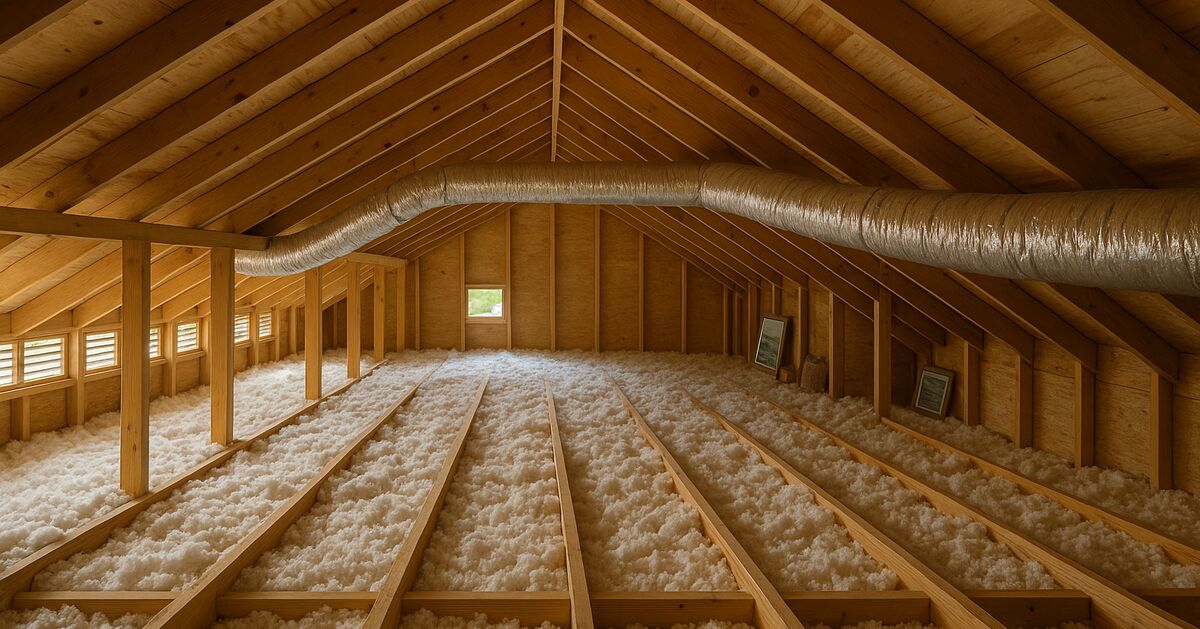
Your attic insulation and your roof are not two separate systems - they are one system, and in Southwest Florida's climate they succeed or fail together. Most homeowners think about insulation only when an energy bill lands in the mailbox and causes sticker shock. By that point, the damage to both the wallet and the roof structure may already be underway. Understanding how these two layers interact is one of the most practical things you can do to protect a home in Sarasota, Bradenton, Lakewood Ranch, or anywhere else along the Gulf Coast.
Why Florida's climate makes the roof-insulation relationship so critical
Most of the country worries about insulation to keep heat in during winter. Florida flips that equation almost entirely. Our job is to stop an enormous amount of radiant and convective heat from pushing into the living space from above, and to do it for the better part of nine months every year.
On a clear July afternoon in Venice or Port Charlotte, a dark asphalt shingle roof can reach surface temperatures above 160 degrees Fahrenheit. That heat radiates downward through the roof deck and into the attic space. If your attic insulation is undersized, poorly installed, or the wrong type for Florida conditions, that thermal energy pours into your conditioned living space. Your air conditioner runs longer, cycling more frequently, which raises electricity costs and shortens the life of the HVAC equipment. The roof itself also suffers: heat trapped in the attic with no way out bakes the underside of the roof deck and accelerates the aging of the underlayment. We wrote at length about what Florida humidity and heat do to your roof underlayment, and the underlayment story and the insulation story are deeply connected.
The ventilation piece you cannot ignore
Before going further into insulation types, it is worth addressing the relationship between insulation and attic ventilation, because confusing the two is one of the most common mistakes homeowners and even some contractors make.
In a traditionally ventilated attic (the most common setup in Sarasota and Bradenton homes), the goal is to allow outside air to flow in through soffit vents at the eaves and exit through ridge vents or gable vents at the peak. This continuous airflow flushes out the super-heated air that builds up under the roof deck. Insulation sits on the attic floor (the ceiling of your living space) and its job is to keep that hot attic air from conducting down into your home.
If you block soffit vents with insulation during installation, you kill the airflow and the entire system breaks down. Heat and moisture have nowhere to go. Moisture is especially dangerous in coastal communities like Nokomis, Osprey, and Anna Maria Island, where the air carries far more humidity than inland areas. Stagnant, humid, superhot attic air is the fastest path to mold on the roof deck, rot in the framing, and premature failure of your roofing materials. Our roofing services page goes into how we assess attic conditions as part of every roof evaluation, because you simply cannot look at the roof in isolation.
Insulation types and how they perform in a Florida attic
Fiberglass batts
Fiberglass batts are the pink or yellow blanket-style insulation that most people picture. They are inexpensive and widely available, which makes them the most common insulation in older homes throughout Sarasota County and Manatee County. Their R-value per inch is reasonable (roughly R-3 to R-4 per inch), and they work fine on the attic floor when properly installed.
The critical word is properly. Batts have to fit snugly against joists with no gaps. Even small gaps and compression points create thermal bridges where heat pours through. In practice, batts in older homes are frequently compressed, displaced by pest activity, or simply undersized for Florida Energy Code requirements. Florida currently requires a minimum of R-38 in attic floors for most climate zone 2 locations (which includes the entire Suncoast), and many homes built before the mid-2000s fall well short of that.
Batts also do nothing to air-seal gaps and penetrations in the attic floor, such as around light fixtures, plumbing chases, and HVAC ducts. Air sealing those gaps before or alongside insulation is not optional in Florida - it is where a significant portion of heat and moisture intrusion happens.
Blown-in fiberglass or cellulose
Loose-fill insulation blown in over the attic floor is an upgrade from batts in most respects. It conforms to irregular framing, fills small gaps more thoroughly, and achieves consistent depth across the entire attic floor. Cellulose (made from recycled paper treated with borate for fire and pest resistance) has a slight edge over blown fiberglass in moisture-buffering capacity, which matters in our humid environment.
Blown-in insulation is a cost-effective way to bring an older home in Englewood or Lakewood Ranch up to current R-value requirements without a major renovation. The caveat: it still needs air sealing underneath it to perform well, and it can settle over time, reducing the effective R-value. A professional installer should account for settling when determining the target depth.
Open-cell spray foam (on the attic floor)
Open-cell spray foam applied to the attic floor combines air sealing and insulation in one step. It is better at sealing penetrations than any blown-in product and achieves a very high level of airtightness. However, open-cell foam is vapor-permeable, meaning moisture can move through it over time. In a ventilated attic that is functioning correctly, this is generally not a problem. In an attic with ventilation issues or in a very high-humidity coastal environment, it is worth discussing with an insulation contractor before committing.
Closed-cell spray foam (on the underside of the roof deck)
This is the approach that changes the entire game for Florida homes, and it is worth understanding on its own terms. When closed-cell spray foam is applied to the underside of the roof deck (rather than the attic floor), the attic itself becomes part of the conditioned or semi-conditioned envelope of the home. This is called an unvented or "hot roof" assembly.
In a hot roof assembly, the attic temperature drops dramatically because the foam is stopping heat at the roof deck rather than at the ceiling below. HVAC ducts running through the attic (a near-universal feature of Florida homes) are no longer sitting in 140-degree air. This alone can produce meaningful reductions in cooling costs, because duct losses in a traditional vented attic on a hot Florida day can be enormous.
Closed-cell foam is also a Class II vapor retarder, meaning it resists moisture migration. For coastal homes in Siesta Key, Anna Maria Island, and Downtown Sarasota where salty, humid air is a constant presence, this vapor resistance adds a layer of protection to the roof deck and framing.
The trade-offs are real. Closed-cell foam costs significantly more per square foot than blown-in insulation. It also makes future inspection of the roof deck more difficult, since the wood is covered. And because the attic is no longer ventilated in the traditional sense, it is critical that the spray foam application is done correctly and that the building's overall moisture balance is managed properly. This is not a DIY project or a job for a crew that has not done hot roof assemblies in Florida conditions specifically.
One important note: if you are planning a roof replacement, the conversation about switching to a hot roof assembly with closed-cell foam should happen before the roofing work begins, not after. The roof installation approach (particularly regarding ventilation details) changes depending on whether the attic will be ventilated or unvented. See our frequently asked questions for more on what to bring up with your contractor before work starts.
How insulation affects roof longevity directly
The connection between poor insulation and shortened roof life runs in two directions.
First, excessive attic heat accelerates the thermal degradation of shingles and underlayment from below. The top surface of your roof is baking in the sun; the underside is baking in trapped attic heat. Both sides cooking simultaneously ages materials faster than the manufacturer's rated lifespan assumes. This is one reason why roofs in Florida often do not reach the lifespan numbers that manufacturers list, even when the installation was done well. How long a roof really lasts on the Suncoast depends heavily on how well the attic system manages heat.
Second, inadequate insulation and air sealing allows warm, moist interior air to contact the underside of a cooler roof deck during cooler nights or rainy periods. This temperature differential can cause condensation on the wood decking. Over months and years, cyclic wetting and drying degrades the adhesion of the decking panels, softens the wood, and can create the conditions for mold or rot. When a roofing crew finds soft or delaminated decking during a replacement, the homeowner faces additional costs for deck replacement on top of the roofing job. Our post on roof decking replacement in Florida covers what those costs look like and when deck replacement becomes unavoidable.
What to look for in your own attic right now
You do not need to be a contractor to do a basic attic check. Here is what to look at:
- R-value: Pull back a small section of insulation and measure its depth. For blown-in fiberglass, divide by about 2.2 to get a rough R-value estimate. If you are below 10 inches of coverage, you are almost certainly below R-38.
- Gaps and bypasses: Look around any penetrations in the attic floor - light fixtures, plumbing pipes, HVAC chases. Any daylight or open gap visible from above is a bypass that lets conditioned air (and humidity) into the attic freely.
- Soffit vents: Look along the eaves to confirm they are not buried under insulation. Baffles or vent chutes should be installed between each rafter bay to keep insulation away from the soffit openings.
- Moisture or staining: Dark staining on the underside of the roof deck or on rafters is a sign of past or ongoing moisture intrusion. This warrants a professional look before adding insulation, since covering a moisture problem traps it rather than solving it.
- Duct condition: If your HVAC ducts run through the attic, check for disconnected flex duct sections and for ducts that are not insulated. Uninsulated ducts in a Florida attic lose a shocking amount of cooling capacity before the air ever reaches a vent.
Making the right choice for your home and location
There is no single correct insulation strategy for every home on the Suncoast. A 1960s concrete block bungalow in Downtown Bradenton has different attic geometry and ventilation conditions than a new construction two-story in Lakewood Ranch. A waterfront cottage on Anna Maria Island faces salt air and humidity conditions that differ from a home several miles inland near Port Charlotte.
What is consistent across all of these is that the insulation system, the ventilation strategy, and the roofing materials above need to be planned as a unit. Homeowners who are about to invest in a new roof have the best opportunity to evaluate and upgrade their attic insulation at the same time, because the roof deck is accessible and the contractors are already on-site. Waiting until after the roof is installed to revisit the insulation means a second mobilization and potentially working around newly installed materials.
If you are curious how your attic and roof are interacting right now - or if you are planning a roof replacement and want to talk through insulation and ventilation options - we are happy to take a look. Our team serves homeowners across Sarasota, Bradenton, and the broader Suncoast service area. Reach out through our contact page to schedule a time that works for you.
Getting the roof-insulation relationship right is not glamorous. It does not make for a dramatic before-and-after photo. But it quietly does the work of keeping your home cooler, your energy bills lower, and your roof in service for as many years as possible - which is exactly the kind of value that adds up over time on a Florida home.