
Florida humidity and heat: what they do to your roof underlayment
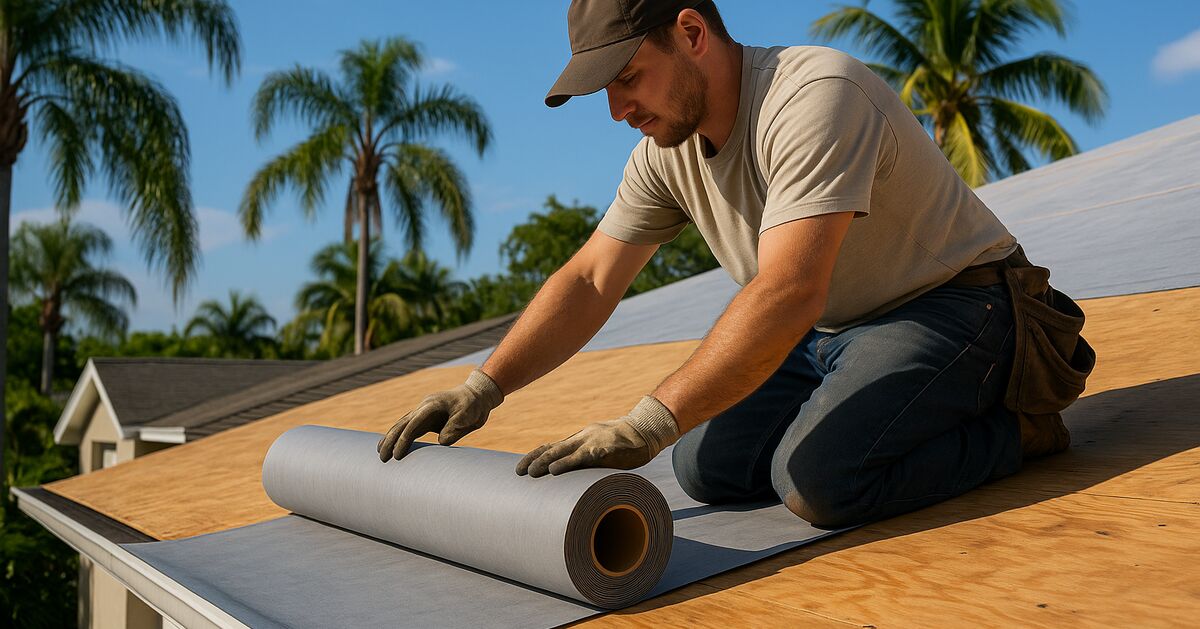
Your roof's surface gets all the attention, but the layer underneath it is often what stands between a dry home and a costly disaster.
Roof underlayment is the water-resistant or waterproof membrane that sits between your shingles, tile, or metal panels and the wooden roof deck below. In most parts of the country, it lives a quiet, uneventful life. In Southwest Florida, it gets baked by sun-driven heat, soaked by daily summer downpours, and slowly attacked by humidity that never really goes away. Understanding what that environment does to underlayment - and what you can do about it - is one of the most practical things a Suncoast homeowner can know.
What underlayment actually does (and why it's not just a backup)
Most people assume underlayment is simply a secondary line of defense in case a shingle blows off. That is part of the job, but only part.
Underlayment does several things simultaneously:
- It keeps wind-driven rain from reaching the roof deck during the gap between a shingle being damaged and a repair crew arriving.
- It prevents moisture vapor that rises from inside the home from condensing against the cold underside of roofing materials.
- It protects the deck during the installation process itself, before the final roofing material goes on.
- On tile roofs especially, it is the true waterproofing layer, because tile alone does not keep water out.
That last point surprises a lot of homeowners. Concrete and clay tile look impenetrable, but they are designed to shed bulk water, not to seal against it. The underlayment underneath is what actually stops rain from reaching the deck. When underlayment fails on a tile roof, you get leaks even though every tile looks perfectly intact from the ground. You can read more about tile-specific issues in our post on tile roof repair in Florida: costs, timelines, and common issues.
How Florida's heat degrades underlayment faster than you expect
Attic temperatures in Sarasota, Bradenton, and the surrounding communities routinely hit 140 to 160 degrees Fahrenheit in summer. That heat radiates upward through the deck and bakes the underlayment from below, while solar gain heats it from above through whatever roofing material sits on top.
Traditional felt underlayment (often called tar paper or 15-lb or 30-lb felt) is made of organic fibers saturated with asphalt. At sustained high temperatures, the asphalt begins to dry out and become brittle. The organic fibers degrade. The material develops small cracks, tears more easily during wind events, and loses its ability to lay flat, which creates gaps. On a steep-pitched roof in Lakewood Ranch where the underlayment gets direct sun during the installation phase before tile is set, you can see felt dry out and curl at the edges within weeks in midsummer.
Synthetic underlayments, which are woven or laminated polypropylene or polyethylene, handle heat significantly better than felt. They resist the drying-out process, stay dimensionally stable at high temperatures, and typically carry longer manufacturer warranties as a result. For most re-roofing projects on the Suncoast today, synthetic underlayment is the sensible standard rather than the premium upgrade.
What humidity adds to the problem
Heat alone would be manageable. Florida also layers on relentless humidity, and that changes the equation considerably.
Moisture attacks underlayment from multiple directions at once:
From above. Wind-driven rain during afternoon storms or tropical systems forces water up under laps and through any small breach in the surface. Even a well-installed roof has a finite number of fastener holes and seams, and underlayment with even minor heat degradation becomes less effective at shedding that infiltration.
From below. Warm, humid air inside the living space rises into the attic. When it contacts cooler surfaces, it condenses. If attic ventilation is insufficient, this moisture has nowhere to go and accumulates against the underside of the deck and the bottom face of the underlayment. Over time this leads to mold, wood rot in the deck, and accelerated breakdown of the underlayment itself. Our post on roof ventilation and why it matters for Florida homes and energy bills goes deeper on this connection.
From the deck itself. If the roof deck ever gets wet - from a leak, from condensation, or from water that got in during a previous storm - and then traps that moisture under the underlayment, the organic material in felt underlayment will absorb it and stay damp. This accelerates rot in the deck and makes the underlayment progressively weaker and more prone to tearing.
The Suncoast's specific climate challenges
Communities along the Gulf Coast from Anna Maria Island and Bradenton in the north to Venice, Englewood, and Port Charlotte in the south share some particular climate characteristics that are worth naming directly.
The salt air environment near the water (think Siesta Key, Osprey, Nokomis, and the barrier islands) adds a corrosive element to the equation. Salt doesn't directly attack the underlayment membrane itself, but it accelerates corrosion in metal fasteners that hold the underlayment down. When a fastener corrodes and the head degrades, the hole it passes through is no longer sealed, and that becomes a path for water.
Coastal communities also see higher sustained wind speeds during storm season, which means underlayment is more likely to be tested by wind-driven rain even during storms that don't make headlines. A tropical storm passing well offshore can still push horizontal rain under eaves and up-slope for hours.
Inland communities like Lakewood Ranch and much of Port Charlotte see slightly less salt exposure but often face more dramatic afternoon convective storms in summer. These produce short, intense rainfall events with high wind gusts that are particularly effective at exploiting any weakness in roof-to-wall intersections, valley areas, and edge details, all of which depend on underlayment being intact and properly lapped.
Types of underlayment and which makes sense here
There are three broad categories you'll encounter in a re-roofing conversation:
Standard felt (15-lb and 30-lb). Still in use, still code-compliant in many applications, but generally the weakest performer in Florida conditions. It's heavier to handle, more prone to tearing during installation, and degrades faster under sustained heat. The lower cost at the materials stage rarely pays off over the life of the roof.
Synthetic non-perforated underlayment. Woven polypropylene products are lightweight, tear-resistant, UV-stable for the exposure period during installation, and dramatically more resistant to heat cycling. Most quality roofing contractors on the Suncoast use a synthetic product as their standard for shingle and metal roofs. Look for products with a minimum 12-month UV exposure rating if your project might involve any delay between underlayment installation and the final roofing material going on.
Self-adhering (peel-and-stick) membranes. These are rubberized asphalt or modified bitumen sheets that bond directly to the deck without fasteners. They create a fully adhered, watertight layer that is the most robust option available. Florida building code already requires self-adhering underlayment at specific high-risk areas: eaves (the first 24 to 36 inches from the roof edge, depending on local requirements), rakes, ridges, valleys, and around penetrations. For tile roofs, some installers and many quality-focused contractors use self-adhering membrane across the entire roof surface rather than just at the code-required zones. This is particularly worth asking about in communities close to the water where wind-driven rain exposure is higher.
Understanding how Florida's building code requirements shape underlayment choices is worth a deeper look - our post on how Florida building codes affect your next roof replacement covers the broader code landscape clearly.
How long should underlayment last in Florida conditions?
This is where homeowners often get a surprise. Felt underlayment in Florida conditions can begin meaningful degradation in as few as 10 to 15 years, sometimes sooner in extreme attic heat situations. A quality synthetic underlayment installed correctly can hold up for 20 to 30 years. Self-adhering membranes, if the deck is dry and clean at installation, can perform well for the full life of the roofing system above them.
The problem is that underlayment is hidden. By the time it's failing visibly, there's usually already moisture reaching the deck. This is exactly why the condition of underlayment is one of the things a thorough roof inspection looks at closely. Signs that a roofer can identify during an inspection include:
- Granule loss from shingles accumulating in valleys (indicates shingle aging that usually tracks underlayment aging too)
- Water staining on the underside of the deck visible from the attic
- Soft spots in the deck (which point to moisture damage that has already reached the wood)
- Evidence of past leak repairs that may have compromised underlayment continuity
- Visible deterioration at flashings and penetrations, where underlayment and metal meet
Our roofing services page has more detail on what a full inspection and re-roofing assessment covers.
What to ask your contractor about underlayment
When you're getting estimates for a re-roof, underlayment is one of the specific line items worth asking about rather than assuming it's handled correctly. Specific questions that matter:
- What underlayment product do you use as your standard, and why?
- Where will you use self-adhering membrane, and does it extend beyond the code minimum?
- How do you handle underlayment at the drip edge, and which goes on first (the answer affects water shedding correctly)?
- If you find deteriorated or wet sections of deck, how is that handled before underlayment goes down?
The last question connects directly to roof decking condition. Putting new underlayment over damaged or wet deck is a common shortcut that leads to early failure. Our post on roof decking in Florida: when it needs replacing and what it costs explains what to look for and what that work involves.
A contractor who gives clear, specific answers to these questions is demonstrating that they think carefully about the system, not just the surface. That's a meaningful signal when you're evaluating who to trust with this work.
The connection between underlayment quality and your insurance
Florida's property insurance environment makes roofing decisions more consequential than they might be elsewhere. Insurers here pay close attention to roof age and condition, and some are scrutinizing what's beneath the surface layer more carefully as part of underwriting decisions. A roof installed with quality self-adhering underlayment and documented materials represents a lower risk profile than one done to bare minimum standards.
If you're navigating the insurance side of a roofing project, our post on Florida insurance market changes and what Sarasota homeowners need to know before replacing a roof is worth reading before you finalize your plans.
Practical takeaways for Suncoast homeowners
If your roof is approaching 15 years old, underlayment condition is one of the most important things to understand before deciding between repair and replacement. A surface that still looks acceptable may be sitting on underlayment that is no longer doing its job reliably.
If you're re-roofing now, push for synthetic underlayment as the minimum standard, and ask specifically about self-adhering membrane coverage beyond code-required areas, particularly at any roof-to-wall intersections, around chimneys or solar penetrations, and in any valley areas.
If you're on a coastal property on Siesta Key, Anna Maria Island, or anywhere else with direct Gulf exposure, this conversation matters even more. Wind-driven rain is not a hypothetical in these locations.
And if you're not sure what condition your current underlayment is in, the right first step is a proper inspection, not guessing based on how the surface looks from the driveway.
We work across the Suncoast from Sarasota and Bradenton down through Venice, Englewood, Nokomis, Osprey, and Port Charlotte. If you want a clear, honest assessment of what's actually happening under your roofing material, reach out and we'll take a look. No pressure, just a straight answer.