
Standing seam vs. exposed fastener metal roofs in coastal Southwest Florida
Salt air quietly destroys metal the way termites quietly destroy wood - slowly, invisibly, and then all at once. If you live near the Gulf on Anna Maria Island, Siesta Key, Englewood, or anywhere along the Suncoast, that reality shapes every roofing decision you make.
Metal roofing has become one of the most popular choices in this region, and for good reason. It handles heat, sheds rain fast, and earns serious wind-resistance credits. But "metal roofing" is not one thing. The two most common residential metal roof systems, standing seam and exposed fastener panels, perform very differently in a coastal salt-air environment. Choosing the wrong one can mean leaks, rust, and premature failure - in a climate that already asks a lot from any roof.
This post breaks down how each system works, where each one struggles, and which makes more sense for homes along the Gulf Coast of Southwest Florida.
How each system is actually built
Understanding the performance difference starts with understanding the physical difference.
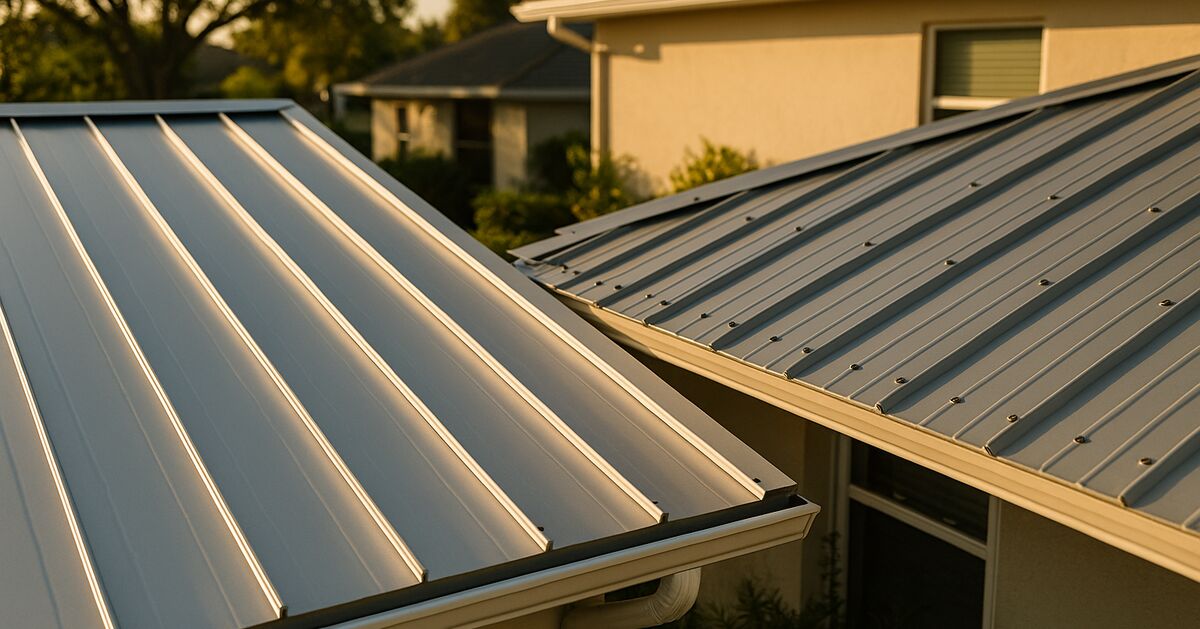
Exposed fastener panels (sometimes called through-fastened or corrugated metal panels) are screwed directly through the face of the metal into the decking or purlins below. Every screw creates a hole through the roofing material. Each screw comes with a rubber or neoprene washer meant to seal that hole. Panels typically overlap at the edges rather than locking together.
Standing seam panels run vertically up the roof slope and connect to each other via raised, interlocking seams - usually 1 to 2 inches tall. Concealed clips hold the panels to the deck without piercing the metal face. No fastener ever punches through the waterproof surface of the panel itself.
That structural difference - holes versus no holes - is the root cause of nearly every performance gap between the two systems in a coastal environment.
What salt air actually does to metal
The Suncoast's proximity to the Gulf means airborne salt particles settle on every outdoor surface, including your roof. Salt is hygroscopic, meaning it draws and holds moisture. When that salt-laden moisture sits against bare metal or around a compromised seal, galvanic corrosion and general rust begin.
The concern is not purely cosmetic. Corrosion around fastener penetrations on an exposed fastener roof can widen the holes meant to be sealed by those washers. Once a washer shrinks, cracks, or pulls away from the metal - which happens faster in Florida's UV intensity than anywhere up north - water has a direct path into your roof deck.
Our post on Florida humidity and heat: what they do to your roof underlayment covers what happens once moisture reaches the layers below the metal. Spoiler: it is not good, and it is expensive. The underlayment and decking can deteriorate long before the metal panel itself looks bad from the street.
Standing seam panels are not immune to salt-air corrosion, but they eliminate the fastener-penetration problem entirely. With no holes punched through the face, there is no entry point for moisture at the fastener location. The panel coating and the interlocked seam carry the full weathering burden.
Coating quality matters as much as panel design
Both panel types come in a range of coating systems, and the coating you choose can matter as much as the panel geometry.
- Galvanized steel uses a zinc coating for corrosion resistance. It is the most affordable base metal but the least suitable for coastal use without a high-quality topcoat.
- Galvalume (a zinc-aluminum alloy coating) outperforms plain galvanized in most corrosion tests and is the industry standard for residential metal roofing in coastal climates.
- Kynar 500 / PVDF paint systems are the premium paint category. They retain color, resist chalking and fading, and hold up against UV far better than polyester-based paints. For homes on Anna Maria Island, Siesta Key, or anywhere within a mile or two of the Gulf, a Kynar-coated Galvalume panel is the starting point for serious coastal durability.
- Aluminum panels skip the rust concern almost entirely. Aluminum does not rust the way steel does. It costs more, weighs less, and is the material of choice for structures right on the water. The tradeoff is that aluminum dents more easily and has slightly less structural stiffness, which matters at wider panel spans.
When comparing quotes, always confirm the base metal, coating type, and paint system. A low-cost exposed fastener roof in plain galvanized steel will not perform the same as a Kynar-coated aluminum standing seam system, even if both are described simply as "metal roofing."
Wind performance along the Suncoast
Hurricane season is a defining factor for any roofing decision here. Sarasota, Bradenton, Venice, Port Charlotte, and the barrier islands all sit in the cone of concern every summer. Metal roofing in general carries strong wind-resistance credentials, but the two systems have different mechanisms of failure under extreme wind load.
Exposed fastener panels rely on those screws to hold the panel to the deck. Under repeated wind uplift cycles, the holes can elongate slightly, washers can compress and lose their grip, and over time panel edges can begin to lift. A well-installed exposed fastener roof with code-compliant fastener spacing performs acceptably, but the failure mode - fasteners working loose - is hard to detect until a storm reveals it.
Standing seam panels use concealed clips that allow the panel to float slightly, accommodating thermal expansion and contraction without stressing the attachment point. The clips themselves are typically rated for very high wind uplift. Because there is no hole through the panel face, there is no elongation failure mode. Standing seam systems consistently achieve higher wind-uplift ratings in Florida Product Approval testing, which matters directly for your insurance underwriter.
Speaking of insurance: your roof's wind-resistance rating feeds directly into wind mitigation inspections. If you are not familiar with how those work in Florida, the relationship between roof type, attachment method, and insurance premium reduction is worth understanding before you choose a panel system.
Thermal movement in a Florida climate
Southwest Florida's daily temperature swing - cool mornings, brutal midday sun on a dark metal roof - can push panel surface temperatures well above 150 degrees Fahrenheit in summer. Metal expands and contracts with every cycle.
Exposed fastener systems handle this by allowing the panel to move slightly around the fastener, but that movement works the hole and washer connection over time. It is one reason exposed fastener roofs in hot climates tend to develop leaks at fastener points before the panel itself fails.
Standing seam panels are designed specifically for thermal movement. The concealed clip floats in a channel that lets the panel slide slightly without stressing any sealed connection. It is an elegant engineering solution to a genuine Florida problem.
Maintenance requirements differ significantly
No metal roof is truly maintenance-free, particularly near salt water.
For exposed fastener roofs, the maintenance checklist includes:
- Inspecting every visible fastener for rust, missing washers, or pullout
- Re-torquing or replacing fasteners that have backed out
- Spot-sealing any washer that has cracked or separated
- Checking panel overlaps for sealant failure
This is not a once-a-decade job. In a coastal environment, an annual inspection and periodic re-sealing is realistic if you want to stay ahead of leaks. Over a 20 to 30-year roof lifespan, the cumulative labor and material cost of that maintenance adds up.
For standing seam roofs, routine maintenance is simpler: keep gutters clear, check that the seams and panel ends are intact, and look for any coating damage or corrosion at cut edges. There are no exposed fasteners to check or re-seal. The time and money savings over decades are real.
Our roofing services page covers the full range of metal roofing work we do across the region if you want to understand what an installation or inspection typically involves.
Which system makes sense for which homeowner?
Neither system is wrong for every situation. Here is a practical breakdown.
Exposed fastener panels may make sense when:
- Budget is the primary constraint and the home is not in a high-salt-exposure zone (generally two or more miles from open water)
- The structure is an outbuilding, lanai cover, or utility building rather than a primary residence
- The pitch is steep enough and the installation is careful enough to minimize standing water at overlaps
- The owner is comfortable with regular maintenance and annual inspections
Standing seam is the stronger choice when:
- The home is on or near the water, on the barrier islands, or within easy range of salt spray
- Long-term performance with minimal maintenance is the priority
- Insurance premium optimization through wind mitigation is a goal
- The home is a significant asset and the roof is expected to last 40 or more years
- Resale value matters - buyers and their inspectors recognize the quality difference
For most of the homes we see in Sarasota, Bradenton, Venice, and Port Charlotte, standing seam is the option we recommend when a homeowner is committed to metal. The additional upfront cost is real, but so is the reduction in long-term maintenance headaches and the stronger performance profile in a hurricane-prone, salt-air environment.
Cost considerations
Standing seam costs more than exposed fastener panels. There is no way around it. The panels are more complex to manufacture, the concealed clip system adds material cost, and the installation requires more skilled labor because the seaming process is exacting.
The cost gap varies with panel profile, coating choice, roof complexity, and current material prices. Rather than quoting a number that may not reflect current market conditions, the honest advice is to get written quotes for both systems side by side and ask each contractor to specify the panel manufacturer, base metal, coating system, and wind-uplift rating. That apples-to-apples comparison will tell you exactly what you are paying for.
If you are factoring in long-term cost of ownership, include the expected maintenance and re-sealing expense of the exposed fastener option over the life of the roof. That math often narrows the gap considerably. And if your insurance carrier offers a meaningful premium discount for a higher wind-uplift-rated roof, that is a real annual savings worth including in the calculation.
For context on how your roof choice intersects with the current Florida insurance market, our post on Florida insurance market changes and what Sarasota homeowners need to know before replacing a roof is worth reading before you finalize a decision.
What to ask any contractor before signing
Whether you go with standing seam or exposed fastener, the quality of the installation matters as much as the system itself. A few questions worth asking:
- What is the Florida Product Approval number for the panel system, and what wind speed is it rated for?
- What is the base metal (steel or aluminum) and the coating system (Galvalume, Kynar, polyester)?
- How will the panel ends and penetrations (pipes, vents, skylights) be sealed?
- What is the warranty on the panel and the paint finish, and who backs it?
- Does the installer carry the manufacturer certification required to issue the full warranty?
These questions are not about being difficult. They are about making sure the roof you are buying matches what was discussed. A reputable contractor will answer all of them without hesitation.
Our FAQ page covers many of the most common questions homeowners ask before committing to a metal roof installation or replacement.
The bottom line
In Southwest Florida's coastal environment, the concealed-fastener design of standing seam metal roofing addresses the two biggest failure modes for metal roofs near salt water: fastener-point corrosion and moisture infiltration at penetrations. That is not a marketing claim. It is basic material science applied to a genuinely harsh environment.
Exposed fastener panels are not a bad product. They are a product that requires more diligent maintenance in a climate that already demands a lot, and they carry a higher long-term risk of leak development right at the points you cannot easily see or access.
If you are weighing a metal roof for a home anywhere from Lakewood Ranch to the barrier islands, the conversation is worth having with someone who knows the local environment. We are happy to walk you through both options, compare panel specifications, and give you an honest recommendation based on your specific home and location. Reach out through our contact page to schedule a free roof assessment.