
How Florida building codes affect your next roof replacement
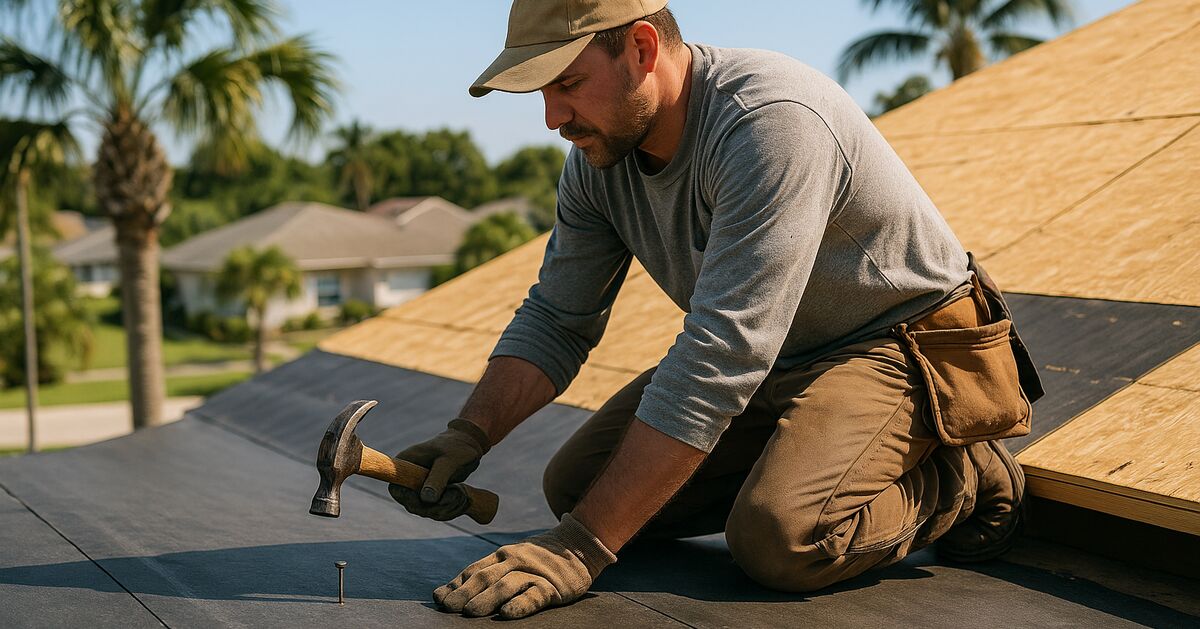
Florida building codes have a way of surprising homeowners at the worst possible moment - right when they're already stressed about a failing roof and a ticking clock. You ask for a simple replacement, and suddenly there's talk of permits, code upgrades, secondary water barriers, and wind-load requirements. None of it is bureaucratic busywork. Every rule exists because Florida's climate has tested roofs to destruction, and the code evolved to stop that from happening again.
Understanding the basics before you start means fewer surprises on your invoice, a smoother permit process, and a roof that will actually perform the way you're expecting it to for the next 20 to 30 years.
Why Florida's roofing code is stricter than most states
After Hurricane Andrew leveled large sections of South Florida in 1992, engineers discovered that the single biggest factor in home survival was roof failure. Roofs that blew off exposed the rest of the structure to catastrophic damage within minutes. The state rewrote its building code from the ground up, and the Florida Building Code (FBC) that governs roofing today is widely regarded as one of the most demanding in the country.
The code is updated on a three-year cycle. The most recent adopted edition affects everything from the fastener pattern on your roof deck to the adhesive used under your tiles. When a contractor says, "we have to do it this way because of code," they almost always mean it. The rules are enforced by the county building department, and inspectors do check.
Here on the Suncoast - covering communities from Bradenton and Lakewood Ranch south through Sarasota, Nokomis, Osprey, Venice, Englewood, and across to Port Charlotte - every jurisdiction operates under the Florida Building Code with local amendments layered on top. Sarasota County, Manatee County, and Charlotte County each have their own building departments, permit fee schedules, and inspection timelines, so the experience of getting a permit can feel a little different depending on which side of a county line your house sits on.
The permit requirement: when you need one and why it matters
In Florida, any re-roofing project that involves replacing the roof covering requires a permit. Full stop. There are limited exceptions for minor repairs (typically under a certain square footage threshold), but if you're having your entire roof replaced, a permit is mandatory.
Why does this matter to you as a homeowner? A few reasons:
- Unpermitted work can void your homeowner's insurance. If a claim is filed and the insurer discovers the roof was replaced without a permit, they have grounds to deny the claim.
- It becomes a problem at resale. Title searches routinely turn up open or missing permits, and an unpermitted roof can kill a real estate deal or force a retroactive inspection at the worst possible time.
- You lose the code-compliance protection. The permit process includes at least one mandatory inspection, which is your independent confirmation that the work was done correctly.
A reputable contractor pulls the permit on your behalf before work begins. If someone offers to skip the permit to save you money or speed up the job, that's a serious red flag. Our FAQ page covers this question in more detail if you want to dig into it further.
The 25% re-roofing rule and code upgrades
One of the most consequential - and most misunderstood - provisions in the Florida Building Code is the rule about what triggers a full code-upgrade requirement.
Here is the core principle: if the repair or replacement affects more than 25% of the total roof area within any 12-month period, the entire roof must be brought into compliance with the current code. This means that patching just enough to stay under the threshold can be a false economy. A homeowner who pays for a repair today and another one six months later may find that the second repair triggers a full re-roof with all current code requirements applied.
What does "brought into compliance" actually mean in practice? It depends on the age and construction of your home, but common upgrades include:
- Secondary water barrier. Homes built before 2008 or so may not have a proper secondary water barrier (sometimes called an underlayment system) that meets current standards. If your full re-roof is triggered, this must be installed. It's the layer that keeps water out if the primary covering is damaged in a storm.
- Roof deck attachment. Older homes may have roof decking fastened with 6d nails on wide spacing. Current code in wind-speed zones common to the Suncoast requires 8d ring-shank nails at 6-inch spacing in the field and 4-inch spacing at edges and ridges. Upgrading the deck attachment can add cost but dramatically improves wind resistance.
- Drip edge. Current code requires a metal drip edge at eaves and rakes. Many older roofs lack this detail, which causes the fascia and roof deck edge to rot prematurely.
This is one of the main reasons a legitimate estimate sometimes looks higher than a quote from a contractor who isn't accounting for code compliance. The lower number often ignores required upgrades. When you're choosing a roofing contractor on the Suncoast, asking specifically how they handle code upgrades in their pricing is one of the best questions you can ask.
Wind speed zones and what they mean for materials
The Suncoast sits within what the Florida Building Code designates as a high-velocity wind region. The specific design wind speed for your property depends on your location and exposure category (how exposed your home is to open water or open terrain).
Anna Maria Island, Siesta Key, and homes directly on the Gulf face higher design wind pressures than an inland home in Lakewood Ranch or northern Port Charlotte. The wind speed designation determines:
- Minimum product approval requirements. Every roofing material and assembly used in Florida must carry a Florida Product Approval (FL#) and must be rated for the wind speed applicable to the installation site. A contractor cannot simply use any shingle, tile, or metal panel they like. They have to verify the product approval covers your wind zone.
- Fastener patterns and spacing. Higher wind zones require tighter fastener spacing, particularly at the perimeter and corners of the roof where uplift forces are greatest.
- Hip roof and geometry advantages. Code recognizes that hip roofs (roofs with four sloping sides) perform better in high winds than gable roofs. This is reflected in wind mitigation credits and can affect what your insurance company charges you. A full re-roof is sometimes the moment homeowners convert gable ends to hip geometry.
If you want to understand how wind resistance ties into your insurance premiums, our post on roof ventilation and energy performance touches on how the construction of your roof affects more than just weather resistance.
Underlayment and secondary water barrier requirements
Florida requires a secondary water barrier on all new and replacement roofs. The purpose is straightforward: if the primary roof covering (shingles, tiles, metal panels) is partially removed or damaged in a hurricane, the secondary barrier is what stands between the exposed deck and the interior of your home.
There are a few approved methods:
- Self-adhering modified bitumen membrane applied directly to the deck (often called "peel-and-stick"). This is the most common and most robust method.
- Inorganic felt with sealed laps, where all overlaps are sealed with approved tape or adhesive.
Some homeowners on older homes in Downtown Sarasota, Downtown Bradenton, or other established neighborhoods are surprised to find that their existing roof has only a single layer of standard felt paper with no secondary barrier at all. It's not a contractor upsell. It's a genuine deficiency that code now requires to be corrected during a re-roof.
The inspection process: what actually happens
Once your contractor has the permit in hand and the work is complete (or at a required stage), a county inspector visits the site. For a typical residential re-roof, there is usually at minimum a final inspection, and sometimes a required inspection at the deck stage before the new covering goes on.
The inspector checks:
- That the permit card is posted and visible
- That the materials installed match what was specified on the permit application and carry valid Florida Product Approval
- Fastener type, size, and spacing at the deck
- Secondary water barrier installation and lap sealing
- Drip edge installation
- Flashing at all penetrations, walls, and valleys
- General workmanship and code compliance
The inspection is a benefit to you, not a burden. It's an independent set of eyes that confirms the contractor did what they said they would do. If an inspection fails, the contractor is required to correct the deficiency and re-inspect before the permit can be closed. A closed permit is your documentation that the work passed.
How code compliance connects to insurance and resale value
Florida homeowners carry some of the highest property insurance premiums in the country, and the age, condition, and code status of your roof is one of the most significant factors insurers use to set your rate or decide whether to offer coverage at all.
A roof that meets current Florida Building Code and was installed under a properly closed permit gives your insurer confidence. It is also the foundation for a favorable wind mitigation inspection report, which can directly lower your premium. If you'd like to explore what the signs are that your roof needs replacing rather than repairing, that post will help you think through the timing of a code-compliant replacement.
When you sell your home, buyers' agents and home inspectors will ask about permit history. A clean permit record for your roof replacement adds to the value of the transaction and removes a potential negotiating chip from a buyer's hand.
What this means when you're getting quotes
When you receive estimates for a re-roof, make sure each quote spells out:
- Whether a permit is included (it should always be)
- How code upgrade requirements (deck re-nailing, secondary barrier, drip edge) are handled and priced
- The Florida Product Approval numbers for the materials being proposed
- Who is responsible for scheduling and passing inspections
A lower number that omits code-required work is not actually a lower number. It's a deferred cost that will either show up as a change order mid-project or, worse, as an unpermitted deficiency discovered years later during an insurance claim or at the closing table.
Our team serves homeowners across the Suncoast and stays current with code requirements in Sarasota County, Manatee County, and Charlotte County. If you have questions about what a code-compliant re-roof looks like for your specific home, take a look at our roofing services or reach out directly for a no-pressure conversation. We're happy to walk through the permit process, explain what upgrades your home may need, and give you a clear, honest estimate that accounts for all of it.
Building codes can feel like an obstacle when you're already dealing with a failing roof. In practice, they're the reason Suncoast homes survive storms that flatten less-regulated construction elsewhere. Every requirement in the Florida Building Code was written in response to something that went wrong. Following them isn't extra, it's the baseline for a roof you can actually count on.