
Why metal roof screws back out on Florida homes - and when it becomes serious
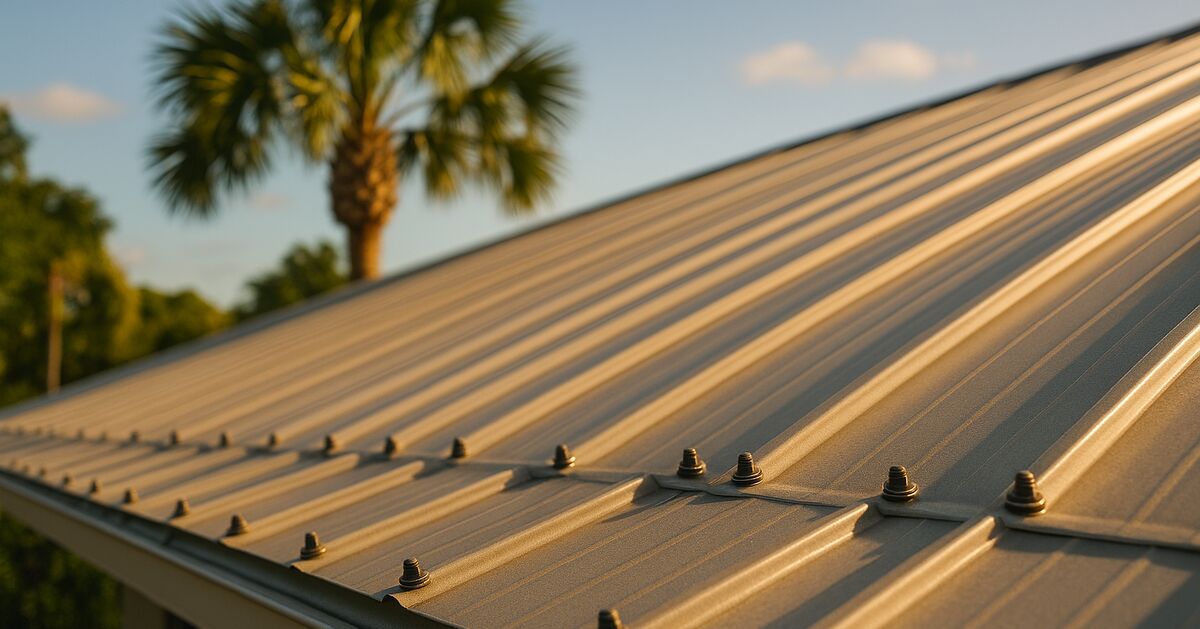
A screw that has backed out a quarter inch from a metal roof panel looks almost harmless. It is not.
That tiny gap between the fastener head and the panel surface is enough to let wind-driven rain funnel straight through the penetration, lift the panel edge during a storm, and start a slow rot process in the roof deck that will not announce itself until water is dripping onto your drywall. Southwest Florida's heat, humidity, and storm cycles make screw back-out a maintenance issue worth watching for on metal roofs. Understanding why it happens is the first step to staying ahead of it.
What actually causes screws to back out?
The short answer is thermal expansion and contraction. Metal panels heat up dramatically under the Florida sun. The U.S. Department of Energy notes that dark metal surfaces can reach temperatures well above ambient air temperature on a clear day, and even lighter-colored metal panels cycle through significant temperature swings between a July afternoon and a pre-dawn morning.
When a steel or aluminum panel heats up, it expands - often lengthwise along the rib. When it cools overnight, it contracts. Every single cycle puts a small rotational force on each fastener because the panel is moving slightly relative to the fixed screw shank. Over months and years, that repeated micro-movement essentially "walks" the screw outward, the same way a bolt can loosen under vibration.
A few factors make this worse on Florida homes:
- Exposed fastener panel systems. In a standing seam roof, the fastener is hidden under a clip and the panel can float a little to accommodate movement. In an exposed fastener system - the corrugated or ribbed metal panels common on residential re-roofs throughout Sarasota, Bradenton, and Port Charlotte - the screw passes directly through the panel face and into the deck or purlin. There is nowhere for the panel to go except to stress the fastener.
- Incorrect fastener length or diameter. A screw that just barely catches the shank of a wood purlin or roof deck has far less holding power than one that penetrates the correct depth. The Florida Building Code, Chapter 15 (Roof Assemblies), references fastener schedules from the approved product's NOA (Notice of Acceptance), and deviating from that schedule - using shorter screws to speed up installation, for example - reduces pull-out resistance from the start.
- Over-driven or under-driven installation. Screws have a neoprene or EPDM bonded washer under the head that creates the watertight seal. Drive that screw too tight and you compress and split the washer, which both weakens the seal and stretches the panel hole slightly, giving the screw more room to migrate. Drive it too loose and the seal never fully forms. Getting this right requires a properly adjusted clutch or torque setting on the drill - something that experienced crews dial in carefully and that hurried or underpaid crews sometimes skip.
- Wrong fastener material for the panel. Aluminum panels with steel screws create a galvanic corrosion pair. Salt air - which reaches well inland from the Gulf, especially in communities like Osprey, Nokomis, Englewood, and Anna Maria Island - accelerates that corrosion. A corroded shank loses thread engagement and backs out more easily. The appropriate fastener material (stainless, coated steel matched to the panel, or aluminum where compatible) matters more in coastal Southwest Florida than it might in, say, an inland northern climate. We cover the corrosion mechanism in more depth in our post on how saltwater air corrodes roof fasteners and flashing on the Suncoast.
- Deck deterioration. A screw can only hold as well as the material it is threading into. If the OSB or plywood deck beneath a metal roof has absorbed moisture over time and begun to delaminate or soften, screw pull-out strength drops sharply. This is especially relevant on older re-roof jobs over existing decking that was not inspected before the metal went on.
When does screw back-out cross from nuisance to serious problem?
Not every slightly loose screw is an emergency. But there are thresholds where the situation changes.
Water intrusion. Once the neoprene washer is no longer seated flush against the panel, rainwater has a direct path through the fastener hole. A single heavy thunderstorm can push enough water through one compromised screw hole to wet the roof deck, start mold growth in the attic, and wick into insulation. If you have multiple backed-out screws across a slope, the cumulative water entry can be significant.
Wind uplift. The Florida Building Code's wind speed maps show that most of Sarasota County, Charlotte County, and the barrier islands are in high-velocity wind zones requiring roofs to meet strict uplift resistance standards. When a screw backs out, the panel is no longer mechanically restrained at that point. Wind can get under the edge, and the uplift load redistributes to the remaining fasteners - increasing stress on each one. In a named storm, a roof with widespread screw back-out can begin to peel before the surrounding intact roofs show any damage at all.
Voided product warranty. Manufacturer warranties on metal roofing systems generally require that the system be installed and maintained per the manufacturer's published guidelines. Those guidelines specify fastener type, spacing, torque, and inspection intervals. If a warranty claim is filed and an inspector finds that fasteners were not maintained or were never installed correctly, the claim can be denied. This is a real-world issue, not a technicality buried in fine print.
Insurance inspection failure. Florida property insurers have tightened inspections significantly. A roof with visible fastener issues could raise concerns during a 4-point inspection, so it's worth addressing before an inspection is scheduled. Given the current state of the Florida insurance market, a preventable maintenance issue like screw back-out is worth addressing proactively. Our roofing services page has more detail on what a professional inspection covers.
How to spot the problem yourself
You do not need to climb on your roof to do a basic check, and in fact we recommend you do not. Instead:
- From the ground with binoculars, look along the rows of screws on any visible slope. A backed-out screw will often cast a small shadow on the panel surface because the head is elevated. In morning or late-afternoon light, this is sometimes visible.
- In the attic after a rain, look for staining or moisture on the underside of the deck near the ridge or upper slopes. Water entry from backed-out screws often tracks down rafters before it becomes visible in living spaces.
- Look for rust halos. Even if a screw has not backed out yet, a ring of reddish-brown staining around the head indicates the washer has failed or the fastener is corroding. Both conditions lead to the same eventual outcome.
- Listen during storms. A metallic tapping or creaking that was not there before can indicate panels that are moving more than they should, which is consistent with loose fasteners.
If you see any of these signs, this is a job for a professional inspection - not a DIY re-tightening. Re-driving a backed-out screw into an oversized or degraded hole just recreates a failed condition. The correct repair involves removing the old screw, assessing the hole and deck below, and installing a larger-diameter fastener or a retrofit sealer system appropriate to the panel type.
What a proper repair looks like
A qualified roofer addressing screw back-out on an exposed fastener metal roof will typically:
- Walk the full roof surface and mark every backed-out or suspect fastener, not just the obvious ones.
- Remove each problem screw and probe the deck for softness or delamination below the hole.
- Where the deck is sound, install a one-size-larger diameter screw of the correct material (stainless or coated as appropriate) with a fresh bonded washer, torqued to manufacturer specification.
- Where the deck is compromised, that section of decking needs replacement before any new fastener will hold. Skipping this step means the repair will fail again within a season or two.
- Apply a compatible sealant cap over any hole that was too large to accept a standard larger screw - this is a secondary measure, not a substitute for proper fastener engagement.
- Document the repairs with photos so you have a maintenance record for insurance or warranty purposes.
For homeowners in Sarasota and Bradenton who have had metal roofs installed in the past decade, a proactive inspection every two to three years is a reasonable maintenance interval given our climate. Roofs closer to the water - Siesta Key, Anna Maria Island, Englewood, or anywhere with frequent salt air exposure - warrant annual checks on fastener condition.
What about re-tightening the screws yourself?
We get this question often. The practical problem is that a screw that has backed out through thermal cycling has usually also enlarged the hole slightly in the panel. Re-driving it to the same depth with the same screw puts the washer in approximately the original position, but the panel material around the hole has been fatigued. In many cases the screw will back out again within a single season. More importantly, you will not know whether the deck below is compromised unless you probe it, and you will not be working with the correct torque unless you have a calibrated tool. The risk of compressing a new washer incorrectly or creating a worse hole is real.
This is also a height and footing safety issue. Metal roofing panels are slippery, especially in the morning dew that is common across the region from spring through fall. OSHA standards on residential roofing (29 CFR 1926.502) exist because falls from roofs are a leading cause of construction fatalities - and those risks apply to homeowners just as much as to workers.
Does this affect shingle or tile roofs?
Screw back-out as a specific mechanism is a metal roofing issue because of the large thermal movement metal panels experience. Shingle roofs use ring-shank or spiral-shank nails, and tile roofs use a combination of mortar, clips, and nails - neither system involves the same exposed threaded fastener dynamic. That said, nail back-out (sometimes called "nail pop") does occur in shingle roofs under different conditions, and it is worth being aware of as a separate issue. If you are comparing metal to other materials for your next roof, our locations page can help you connect with a local specialist who knows which systems perform best in your specific neighborhood.
Planning ahead: permits, products, and local codes
One detail that surprises some homeowners is that even a repair involving fastener replacement on a metal roof may require a permit in certain jurisdictions depending on scope. Charlotte County, Sarasota County, and Manatee County each have their own thresholds for what constitutes a re-roof versus a repair. Our post on how Florida building codes affect your next roof replacement explains the general framework. For permit specifics in Port Charlotte versus Sarasota, the differences can be meaningful - both in timing and in what documentation you need.
If you are not sure whether your metal roof's fasteners are in good shape, the most practical step is a professional inspection before hurricane season begins in June. Catching backed-out screws in March or April gives you time to schedule repairs without competing against the post-storm rush that fills contractor calendars from July onward. You can reach us directly through our contact page to schedule an inspection throughout our service area, from Venice and Englewood up through Lakewood Ranch and across to Nokomis and Osprey.
A small screw, backed out a quarter inch. It is worth paying attention to.
Sources & further reading
- Florida Building Code, Chapter 15 - Roof Assemblies and Rooftop Structures (Florida Building Commission)
- Metal Building Manufacturers Association (MBMA) Metal Roofing Systems Design Manual (Metal Building Manufacturers Association)
- U.S. Department of Energy - Building Technologies Office: Roofing and Thermal Performance (U.S. Department of Energy)
- Occupational Safety and Health Administration (named in this article) (Occupational Safety and Health Administration)
Claim-by-claim audit (7 checked)
- “Southwest Florida's heat, humidity, and storm cycles make screw back-out a maintenance issue worth watching for on metal roofs.” (rewritten to what the article can stand behind)
- “The U.S. Department of Energy notes that dark metal surfaces can reach temperatures well above ambient air temperature on a clear day, and even lighter-colored metal panels cycle t…” (rewritten to what the article can stand behind)
- “A single heavy thunderstorm can push enough water through one compromised screw hole to wet the roof deck, start mold growth in the attic, and wick into insulation.” (rewritten to what the article can stand behind)
- “Manufacturer warranties on metal roofing systems generally require that the system be installed and maintained per the manufacturer's published guidelines.” (rewritten to what the article can stand behind)
- “A roof with visible fastener issues could raise concerns during a 4-point inspection, so it's worth addressing before an inspection is scheduled.” (rewritten to what the article can stand behind)
- “The Florida Building Code's wind speed maps show that most of Sarasota County, Charlotte County, and the barrier islands are in high-velocity wind zones requiring roofs to meet str…” (cited → floridabuilding.org)
- “OSHA standards on residential roofing (29 CFR 1926.502) exist because falls from roofs are a leading cause of construction fatalities - and those risks apply to homeowners just as …” (cited → osha.gov)