
How saltwater air corrodes roof fasteners and flashing on the Suncoast
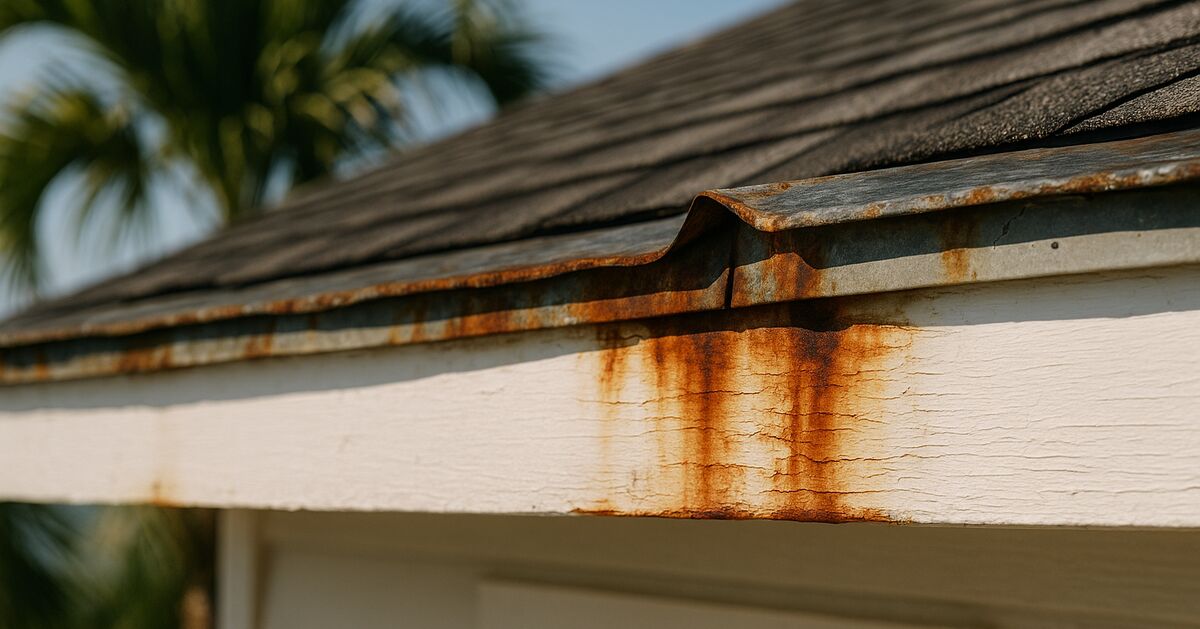
Salt is invisible, patient, and relentless. Long before a homeowner in Siesta Key or Anna Maria Island notices a rust stain on their fascia or a lifted shingle near the ridge, saltwater air has already been eating away at the metal components holding that roof together. Fasteners, flashing, drip edges, pipe collars, ridge caps, and clips - none of them are immune, and the Gulf Coast environment accelerates the process far faster than most manufacturers' warranty language anticipates.
This post is a deep dive into the chemistry of coastal corrosion, the specific components most at risk, and the materials that genuinely hold up when you live within a few miles of saltwater. If you're in Sarasota, Bradenton, Lakewood Ranch, Venice, Englewood, Nokomis, Osprey, Port Charlotte, or anywhere else on the Suncoast roofing service area, this is worth reading before your next inspection or replacement.
Why saltwater air is so much more corrosive than regular humidity
Florida is humid everywhere - that much is well known. But there is a significant difference between the inland humidity of, say, Orlando and the salt-laden air that rolls off Tampa Bay, Sarasota Bay, Charlotte Harbor, or the Gulf itself. The difference comes down to chloride ions.
When seawater evaporates or wave action generates aerosols, tiny salt particles become suspended in the air. These particles travel inland - sometimes several miles, depending on wind conditions - and deposit on every surface they contact, including your roof. When those chloride ions land on metal in the presence of moisture (and on the Suncoast, moisture is almost always present), they disrupt the thin oxide layer that would otherwise protect metals like steel and aluminum from oxidation. Without that protective layer, the underlying metal corrodes rapidly through a process called pitting corrosion, which eats into metal from the inside out rather than just tarnishing the surface.
The closer your home is to open water, the more intense this effect. Homes directly on the beach in Siesta Key, Englewood, or Anna Maria Island can see fastener corrosion in as little as five to ten years with the wrong materials. But even homes several miles inland in Lakewood Ranch or Port Charlotte are not fully insulated from the problem, since salt aerosols travel farther than most people realize, especially during storm events and onshore wind patterns.
The components most vulnerable to coastal corrosion
Understanding where corrosion attacks first helps you know what to look for during inspections and what to insist on during any roofing work.
Roof fasteners (nails and screws)
Fasteners are the single most corrosion-critical component in any roof system. A standard galvanized roofing nail has a zinc coating that sacrifices itself to protect the underlying steel - this is called galvanic protection. On a standard inland installation, that zinc coating can last decades. On the Gulf Coast, it can be consumed in a fraction of that time.
When the zinc is gone, the steel nail begins to rust. A rusting nail expands slightly as iron oxide forms, which can crack the surrounding shingle or tile and create a small but reliable water entry point. Eventually the nail shaft weakens and loses its grip, allowing shingles to lift in wind events. This is one reason coastal homes can suffer disproportionate damage in storms: the fasteners holding the roof together are already compromised before the first gust arrives.
What actually holds up: ring-shank stainless steel nails (Type 304 or Type 316) are the gold standard for coastal applications. Type 316 has added molybdenum and is specifically formulated for marine environments. For metal roofing screws, look for coated stainless or EPDM-gasketed stainless options - not the standard zinc-plated screws that come in bulk boxes.
Flashing
Flashing is the metal sheeting used to seal transitions and penetrations: the joints where your roof meets a wall, chimney, skylight, vent pipe, or dormer. It is exposed to the elements with no shingle cover, which means it takes the full force of coastal air, rain, and UV simultaneously.
Standard galvanized steel flashing has a notoriously short service life in Sarasota and Manatee counties. Rust bubbles typically appear first at cut edges and fastener holes, then spread across the surface. Once flashing rusts through, it loses its sealing ability and water intrusion follows quickly.
Aluminum flashing is a common upgrade, but it carries its own coastal risk: galvanic corrosion. When aluminum is in direct contact with steel fasteners or steel decking components, the two dissimilar metals in the presence of salt moisture create a small electrochemical cell. The aluminum (the more active metal in most pairings) corrodes preferentially and can fail faster than galvanized steel in some configurations.
What actually holds up: copper flashing is the most durable coastal option and will outlast the roof itself under normal conditions. It is more expensive upfront, but the long service life makes it cost-effective over time. Where copper is not in the budget, lead-coated copper or high-quality aluminum with dielectric separation from any steel fasteners is a reasonable alternative. For pipe boots and collars, two-piece neoprene/stainless steel options significantly outperform the standard plastic-and-galvanized versions on coastal roofs.
Drip edge
Drip edge runs along every eave and rake of your roof and is, almost by definition, a piece of metal that sits at the outermost edge of the structure with maximum exposure to salt air. Standard G-90 galvanized drip edge is the code minimum and is perfectly adequate for inland Florida. On the Suncoast, it often begins to surface-rust within three to five years and can develop through-rust holes within ten.
What actually holds up: aluminum drip edge (properly isolated from dissimilar metals) or factory-coated steel with a Kynar or PVDF finish. Some contractors in coastal Sarasota and Charlotte County are now specifying painted aluminum drip edge with a baked-on finish, which provides both corrosion resistance and color matching for tile systems.
Ridge cap fasteners and hip caps
Ridge caps on tile roofs are often set in mortar and secured with concealed clips or exposed screws. Exposed screws on ridge tiles are a frequent corrosion problem: the screw head eventually rusts, bleeds rust staining down the tile, and eventually loses its grip. The mortar itself can crack when fasteners expand with rust, creating pathways for water even if the mortar looked intact from the ground.
Roof-to-wall connections and hurricane straps
This is less visible but critically important. The metal hurricane straps and clips that connect your roof structure to the wall framing are inside the attic, but they are not immune to the salt air that infiltrates through soffit vents. In homes close to the water in Downtown Sarasota, Nokomis, or Osprey, these structural connectors can show significant corrosion over time. A wind mitigation inspector should be flagging this, but it is worth asking about specifically on any home within a mile or two of open water.
How to tell if your existing roof has corrosion issues
You do not always need to get on the roof to get early warning signs. Here is what to look for from the ground and during an attic inspection:
- Rust staining on the fascia or soffit directly below a roof edge often means the drip edge has corroded through and is bleeding rust into the water runoff.
- Dark streaking around pipe penetrations can indicate a failed pipe boot collar, sometimes from corrosion of the metal ring, sometimes from UV degradation of the rubber - but on coastal homes, metal corrosion is a likely contributor.
- Lifted or loose shingles near the ridge or edges without obvious storm damage can point to fastener failure below the surface.
- Staining on the underside of the roof deck in the attic around any metal penetration is worth investigating immediately.
- Visible rust on the exposed ends of hip and ridge cap screws on tile roofs is a clear indicator that a fastener upgrade is overdue.
Our frequently asked questions page covers inspection intervals, but the short version for coastal homes is: annual visual checks and a professional inspection every two to three years are not excessive if you live near the water.
What the building code says - and what it does not say
Florida's building code has improved significantly since the mid-2000s revisions that followed the 2004 and 2005 hurricane seasons. The current Florida Building Code does require corrosion-resistant fasteners in coastal high-velocity hurricane zones and in areas with certain wind speed designations. However, "corrosion-resistant" under the code can legally be satisfied by standard galvanized fasteners in many applications - a standard that does not reflect the actual corrosion environment within a few miles of the Gulf.
This is one of those situations where meeting code is not the same as specifying what is right for your location. A contractor who defaults to the code minimum on fasteners and flashing in a coastal Sarasota or Englewood installation is not doing anything wrong by the letter of the law - but they may be leaving you with components that will fail prematurely. It is worth asking explicitly what grades of fastener and flashing material are being specified, and why.
For a broader look at how Florida building code shapes roofing decisions, see our post on how Florida building codes affect your next roof replacement.
Material choices that make a difference at the system level
Individual component upgrades matter, but the overall roofing system also plays a role in how quickly corrosion compounds.
Metal roofing: If you are considering a metal roof, the standing seam vs. exposed fastener question is directly relevant to corrosion. Exposed fastener systems, as the name implies, leave hundreds of screw heads visible and directly exposed to salt air and UV. Standing seam systems hide fasteners under the panel seams, dramatically reducing corrosion exposure. We covered this in detail in our post on standing seam vs. exposed fastener metal roofs in coastal Southwest Florida. For coastal homes, standing seam with a Kynar-coated steel or aluminum panel is a genuinely long-lasting option.
Tile roofing: Concrete and clay tile themselves are essentially inert to salt air - the tile body will not corrode. The vulnerability in tile systems is entirely in the metal components: the clips, mortar screws, flashing, and underlayment fasteners. Specifying stainless or coated stainless hardware throughout a tile installation is the most important corrosion-related decision for coastal tile roofs. See our piece on tile roof repair in Florida for more on what goes wrong and when.
Asphalt shingle roofing: The shingles themselves are not the corrosion concern - the fasteners are. On coastal shingle installations, stainless ring-shank nails are worth the modest cost premium. The underlayment is also a factor; a fully adhered self-sealing underlayment reduces the role of individual fasteners in keeping water out if a nail does corrode and lose its grip. Our post on Florida humidity and heat: what they do to your roof underlayment goes deeper on underlayment selection for this climate.
Proximity to water matters more than you might think
We see a real gradient in corrosion rates across our service area. A home on the water in Anna Maria Island or on the bay side of Siesta Key is in a categorically more aggressive environment than a home ten miles inland in Lakewood Ranch or central Port Charlotte. But the gradient is not linear - saltwater aerosol transport during onshore winds or storm events means that neighborhoods two or three miles from the water can still see significantly accelerated corrosion compared to true inland areas.
If you are in Sarasota or Bradenton and within sight of the bay or within a few blocks of a tidal waterway, treat your home as a coastal installation for roofing purposes. The same applies to most of Venice, large portions of Englewood, and the waterfront communities of Port Charlotte.
Wherever you are on the Suncoast, it is worth knowing your specific location's exposure level before your next roofing contract is written - because the specification sheet that is appropriate for a home in inland Lakewood Ranch may leave a waterfront home in Osprey with components that underperform their expected lifespan.
What to ask your contractor before signing anything
When you get roofing estimates for work on a coastal home, here are specific questions worth asking:
- What grade and specification of nails are you using? Are they stainless steel, and if so, what alloy - 304 or 316?
- What material is the flashing, and how will you prevent galvanic corrosion at metal-to-metal contacts?
- What is the drip edge material and finish?
- For tile roofs: are the ridge and hip cap fasteners stainless?
- Are the pipe boots two-piece metal-and-neoprene units, or standard plastic?
- Is the underlayment system fully adhered, or mechanically fastened only?
A contractor who can answer these questions confidently and explain the reasoning is one who understands coastal installations. If the answer is "we use what the code requires," that is worth probing further.
You can see the full range of roofing services we provide, including coastal-specific specifications, on our roofing services page, or get in touch directly if you want a site-specific assessment of your home's exposure level and current hardware condition.
Saltwater air does not announce itself - it just works, quietly and constantly, on every unprotected metal surface your roof has. The good news is that the materials to resist it exist, they are proven, and in most cases the cost premium over standard hardware is modest compared to the cost of a premature repair or a water intrusion event. Knowing what to ask for is half the battle.