
Wind Mitigation Inspections: How They Lower Your Florida Home Insurance
Florida homeowners pay some of the highest property insurance premiums in the country, and your roof is the single biggest reason why. A wind mitigation inspection is one of the few tools available to you that can actually push that number down, sometimes by a significant amount, without you spending a dime on renovations first. Understanding how it works puts real money back in your pocket.
What Is a Wind Mitigation Inspection?
A wind mitigation inspection is a formal evaluation of how well your home is built to resist hurricane-force winds. A licensed inspector examines specific construction features, documents them on a standardized state form, and submits that form to your insurance carrier. Your insurer then applies credits to your premium based on what the inspection reveals.
The process is governed by Florida's Office of Insurance Regulation. The standard form used is called the OIR-B1-1802, and every insurance company doing business in Florida is required to accept it. That means the credits are not a favor your insurer can choose to ignore, they are a regulatory obligation.
Inspections typically take one to two hours and cost somewhere in the range of $75 to $150, depending on the size of your home and who you hire. Given that the resulting insurance discounts can run into the hundreds of dollars annually, most homeowners recover the inspection fee within the first month or two of the new policy period.
Why Your Roof Dominates the Entire Inspection
Of all the features an inspector evaluates, your roof accounts for the largest share of the available credits. This makes sense when you consider the physics: during a hurricane, the roof is the first major structural component to encounter wind load. If it fails, the rest of the house becomes vulnerable almost immediately.
The inspection breaks roof-related features into several categories.
Roof covering. The type and age of your roofing material matters. A relatively new roof installed to current Florida Building Code standards earns better credits than an older one installed to a prior code. This is one reason homeowners in Sarasota roofing and across the Suncoast find that a recent roof replacement pays dividends beyond just stopping leaks, it often triggers a meaningful insurance discount as well.
Roof deck attachment. Inspectors look at how the sheathing (the plywood or OSB panels) is fastened to the rafters or trusses underneath. Longer nails at tighter spacing create a stronger connection. Homes built after the mid-1990s code updates generally perform well here. Older homes in places like Bradenton and Port Charlotte that were built decades ago may show the older 6d nail pattern, which earns lower credits.
Roof-to-wall connection. This is arguably the most critical factor in the entire form. It describes how the roof structure is tied down to the exterior walls below it. There are four levels, from weakest to strongest: toe nails, clips, single wraps, and double wraps (also called hurricane straps or clips). Each step up the ladder corresponds to a larger insurance discount. Double wraps, which are common in homes built after Hurricane Andrew in 1992 forced Florida to overhaul its building codes, can generate substantial credits on their own.
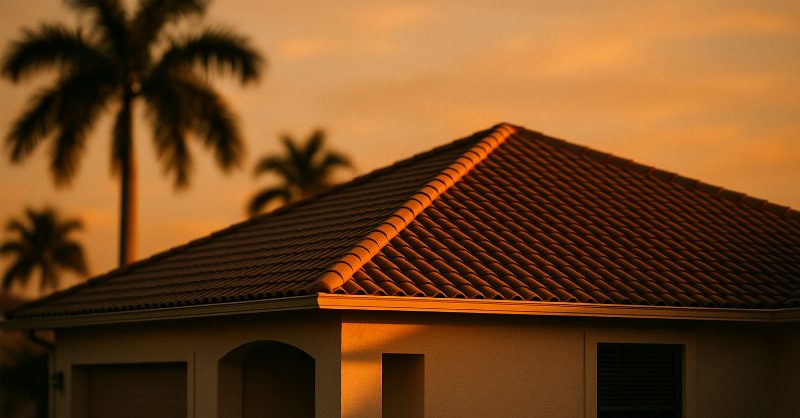
Roof shape. A hip roof, where all four sides slope downward to the walls, performs better aerodynamically than a gable roof, where two sides are vertical triangular end walls. Insurers recognize this and credit hip roofs accordingly. If your home has a hip roof with minimal flat sections, you stand to benefit. Many newer homes in Lakewood Ranch and newer developments across the Suncoast are built with hip roofs specifically because of how well they perform in wind events.
Opening protection. While not strictly a roof feature, this section covers windows, doors, and skylights. Inspected items include whether openings are protected with impact-rated glass, accordion shutters, or other approved systems. Strong opening protection reduces the risk of sudden pressure changes inside the home that can cause a roof to lift from the inside out.
Who Can Perform the Inspection?
Florida law specifies which license types are authorized to complete an OIR-B1-1802 wind mitigation inspection. Eligible inspectors include licensed home inspectors, contractors, building inspectors, architects, and engineers. The important thing is that the person you hire is properly licensed and familiar with the form, because errors or omissions on the report can result in credits being denied.
A roofing contractor who is actively familiar with current installation standards can be a particularly valuable resource here. If your inspection reveals features that are earning you reduced credits, a qualified roofer can explain what an upgrade would actually involve and whether the long-term insurance savings would justify the cost.
You can read more about what inspectors look for during a broader roof evaluation in our post on what a roof inspection actually checks and how often you need one.
How Big Can the Discounts Be?
This varies by insurer and by the specific combination of features your home has. There is no single universal discount table, because each insurance company files its own rate structure with the state. What can be said with confidence is that the discounts are real and often substantial.
Homes with strong roof-to-wall connections, hip roofs, and modern deck attachment commonly see premium reductions of 20 to 45 percent on the wind portion of their policy. The wind portion is typically a large share of a Florida homeowner's total premium, so even a 25 percent reduction on that slice translates to meaningful savings in dollar terms.
Conversely, a home with minimal protective features may receive little or no discount. The inspection still has value in that case because it gives you a clear picture of where your home stands and what upgrades would move the needle.
When to Get One and How Long It Stays Valid
Wind mitigation reports are generally valid for five years. After that, your insurer may require a new inspection to continue receiving the credits. If you have had any roof work done, including a full replacement, a re-deck, or significant structural repairs, it is worth getting a new inspection even before the five-year mark. A roof replacement often upgrades the deck attachment method, the covering type, and sometimes the overall geometry of the roof in ways that can unlock additional credits.
Homeowners who have recently moved to the area and purchased an older home in communities like Venice, Nokomis, or Englewood should not assume that a prior inspection on file is still accurate. If the previous owner did not update the roof or shutters, the report may reflect features that no longer earn optimal credits under current insurer guidelines.
The Connection Between Your Roof's Condition and Insurance Eligibility
It is worth separating two related but distinct concepts. A wind mitigation inspection tells your insurer how your home is built. A standard roof inspection tells you and your insurer whether your roof is in serviceable condition. Insurers in Florida have become increasingly willing to non-renew or decline to renew policies on homes with aging or damaged roofs, regardless of what the wind mitigation form says.
If your roof is approaching the end of its useful life, the more pressing conversation may be about replacement rather than credits. Our post on how long a roof really lasts on the Suncoast goes into detail on what to expect from different materials in our climate. And if you are already seeing signs of wear, our guide on physical signs your roof needs replacing, not just patching can help you figure out where you stand.
The good news is that a new roof and a wind mitigation inspection are natural partners. If you are replacing your roof anyway, scheduling the inspection shortly after the work is complete lets you lock in credits based on current, code-compliant installation.
What to Do After the Inspection
Once you have the completed OIR-B1-1802 form in hand, submit it to your insurance agent or carrier directly. Do not wait for your next renewal. Most insurers will apply the credits at mid-term and prorate the savings for the remainder of your current policy period.
Keep a copy of the form yourself. You will need it when you switch carriers or shop for better rates. Because the form is standardized, a competing insurer will accept the same document, which simplifies the process of comparing quotes.
If the inspection reveals areas where your home underperforms, ask your inspector to explain specifically what would need to change to earn the next tier of credit. Sometimes the answer is a relatively modest upgrade. Other times it is a larger project, but knowing the numbers on both sides of the equation, the cost of the improvement versus the annual insurance savings, lets you make an informed decision.
Local Considerations Across the Suncoast
The communities we serve span a wide range of housing stock and construction eras. Neighborhoods on Anna Maria Island and older parts of Downtown Sarasota include homes built well before modern wind codes existed. These properties often have the most to gain from understanding their current standing and what improvements are available.
Newer master-planned communities in places like Lakewood Ranch and parts of Osprey were generally built to post-Andrew codes and may already be earning strong credits. Still, it is worth confirming this with a current inspection rather than assuming.
Our roofing services include post-installation consultation on the features that affect wind mitigation ratings, and our team is happy to answer questions about what your specific roof type and installation details might mean for your insurance form. If you have questions about our work or our service area, our frequently asked questions page covers the most common topics, or you can get in touch with us directly to talk through your situation.
A wind mitigation inspection is one of the smartest and lowest-cost steps a Florida homeowner can take. It does not change your roof, but it makes sure the roof you have is getting you every credit it deserves.