
How Long Does a Roof Really Last on the Suncoast?
Your roof's warranty says 25 years. Your neighbor's roof is being torn off after 14. Welcome to the Suncoast.
Living in Sarasota, Bradenton, Lakewood Ranch, or anywhere else along this stretch of Southwest Florida means accepting a simple truth: roofing materials age faster here than in almost any other part of the country. The combination of intense UV radiation, salt-laden air, relentless summer humidity, and the annual threat of tropical storms creates a stress environment that manufacturers' lifespan estimates simply were not built around. Those numbers on the package are typically based on temperate-climate testing, not on a roof baking at 160°F on a July afternoon in Venice or Englewood.
This post is going to give you honest, specific answers. How long should each material actually last here? What shortens that lifespan? And how do you know when you're approaching the end of the road?
Why Florida Is Harder on Roofs Than Anywhere Else
Before we get into numbers, it helps to understand the forces working against your roof every single day.
UV radiation is the silent killer. Sarasota sits at roughly 27 degrees north latitude, which means the sun's angle is steep and intense year-round. UV rays break down the asphalt binders in shingles, the resins in tile coatings, and the elasticity in seals around flashing and penetrations. A shingle roof that might last 25 years in Ohio can lose 30-40% of its effective lifespan simply from UV degradation in a Florida climate.
Heat cycling compounds the damage. Temperatures on a dark shingle roof regularly exceed 150-160°F in summer. At night, the roof cools dramatically. This expansion and contraction cycle, repeated thousands of times over a roof's life, works nails loose, cracks sealants, and causes shingles to curl and split along their edges.
Humidity and moisture intrusion are constant concerns from Nokomis to Port Charlotte. High ambient humidity means that even minor gaps in your roof system, a cracked ridge cap, a worn pipe boot seal, or a loose piece of flashing, can allow moisture to wick in and begin rotting the decking beneath the surface layer. By the time you see a stain on your ceiling, the structural damage can already be significant.
Salt air is especially relevant for homeowners closer to the water, on Anna Maria Island, Siesta Key, or in Downtown Sarasota and coastal Osprey. Salt accelerates corrosion on metal components like flashing, drip edges, and fasteners. It also degrades the granule coating on asphalt shingles faster than inland locations.
Hurricane season runs from June through November and brings not just the obvious threat of direct storm damage but also sustained high winds, wind-driven rain, and airborne debris that can compromise even a structurally sound roof. For more on preparing your roof before the season starts, see our guide on how to prepare your Florida roof for hurricane season.
Realistic Lifespan by Roofing Material on the Suncoast
Here is what you should realistically expect from each major roofing type in our climate, not manufacturer marketing numbers but honest field experience.
3-Tab Asphalt Shingles
Realistic lifespan: 10-15 years
This is the most affordable shingle option and the shortest-lived one in Florida. Three-tab shingles are lightweight and have a single flat layer, which means they flex more dramatically in heat and offer less resistance to wind uplift. In Bradenton, Lakewood Ranch, and similar inland locations, a well-installed 3-tab roof might reach 15 years with good maintenance. In coastal or more exposed areas, 10-12 years is a more realistic expectation. If your home has 3-tab shingles and is approaching the decade mark, start paying close attention.
Architectural (Dimensional) Asphalt Shingles
Realistic lifespan: 15-20 years
Architectural shingles are heavier, laminated, and more wind-resistant than 3-tab. They're the most common choice on new homes throughout Sarasota County and Manatee County for a reason: they offer a meaningful improvement in durability without a dramatic jump in cost. A quality installation in an inland area like Lakewood Ranch could reach 20 years. In high-UV or coastal environments, plan on closer to 15-17 years before you start seeing issues that warrant replacement rather than repair. Our post on how to tell when your Florida roof is done versus just needing a repair walks through exactly how to make that call.
Impact-Resistant (Class 4) Shingles
Realistic lifespan: 18-25 years
These are premium asphalt shingles engineered with a modified polymer matrix that resists hail and wind-driven debris. In a hurricane-prone market like ours, they're worth serious consideration. They cost more upfront but often qualify for homeowner's insurance discounts in Florida, and they hold up meaningfully better against the kind of debris impacts that come with tropical weather. Expect 20-22 years as a realistic midpoint in Suncoast conditions.
Concrete and Clay Tile
Realistic lifespan: 25-40+ years
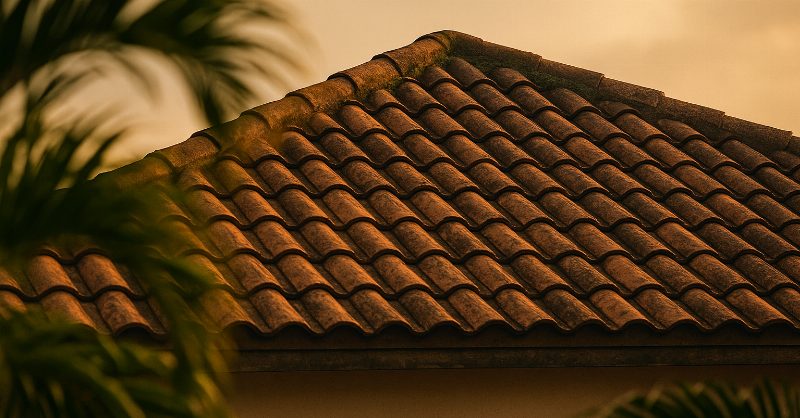
Tile is extremely popular throughout Sarasota, Venice, Englewood, and the surrounding area because it genuinely performs well in Florida's climate. The tile itself is resistant to UV, salt, and insects. It does not rot. In many cases, the tile will outlive the underlying components. Here is the important nuance: tile roofs fail not because the tiles crack (though they can, especially under foot traffic or from falling branches) but because the underlayment beneath the tile degrades. Traditional felt underlayment under tile may only last 15-20 years before it begins to fail, even when the tile above it looks fine. Modern synthetic underlayments extend that life considerably. If you have a tile roof, the age of the underlayment is just as important as the age of the tile. A professional roof inspection can assess the underlayment's condition without requiring a full tear-off.
Metal Roofing
Realistic lifespan: 35-50+ years
Standing seam and metal panel roofing systems are the longest-lived option available on the Suncoast. Metal handles UV, heat cycling, and high winds exceptionally well. It is the least susceptible to moisture intrusion of any roofing material. The main vulnerability in coastal areas is corrosion on fasteners and trim pieces, which is why material selection and coating quality matter significantly. A properly coated steel or aluminum standing seam roof on a home in Port Charlotte or Osprey should comfortably last 40 years with basic maintenance. Metal is increasingly common on both new construction and re-roofing projects throughout our area because the longer replacement cycle often makes it cost-effective over time, even with higher upfront costs.
Single-Ply Flat Roofing (TPO, Modified Bitumen)
Realistic lifespan: 15-25 years
Flat and low-slope roofing systems are common on commercial buildings and on certain residential styles throughout the Suncoast. TPO membranes, when properly installed and seamed, perform well in heat and UV. Modified bitumen is extremely durable but can blister in intense heat if not properly adhered. Both systems depend heavily on installation quality and ongoing maintenance of drains, seams, and penetration seals.
What Shortens a Roof's Life Prematurely
Material choice matters, but installation and maintenance are just as important. Here are the most common reasons Suncoast roofs fail before their time.
- Poor attic ventilation. An under-ventilated attic traps heat and moisture that cook the roof deck and shingles from below. This is one of the most overlooked factors in premature roof aging in Florida.
- Skipped or improper underlayment. The underlayment is your secondary line of defense. Using cheap or incorrectly installed underlayment shortens everything above it.
- Ignored minor repairs. A cracked pipe boot seal or a small area of lifted flashing might cost a few hundred dollars to fix. Left alone for two or three years, that same issue can lead to rotted decking and a much larger repair bill. See our post on the physical signs your roof needs replacing, not just patching for guidance on when small problems signal something bigger.
- Pressure washing tile or shingles aggressively. This strips granules from shingles and can crack tiles or force water under them. Use low-pressure soft washing only.
- Walking on the roof carelessly. Tile is particularly vulnerable to cracking underfoot if you do not know the safe walking lines. Never let an untrained person walk your tile roof for any reason.
- Storm damage that goes un-inspected. After a significant weather event, many homeowners look at their roof from the ground, see nothing obviously wrong, and move on. Hidden damage to flashing, ridge caps, or underlayment can allow water intrusion for months before any interior sign appears. If you've had a major storm, get an inspection. If damage is found, our guide on how to file a roof insurance claim in Florida explains the process step by step.
How Often Should You Have Your Roof Inspected?
The general guidance in Florida is once a year, and once after any significant storm event. Annual inspections are not about finding reasons to replace your roof. They are about catching small problems early, when they are cheap and easy to fix, and getting an honest assessment of how many useful years your roof has left. For a full breakdown of what inspectors actually look at and why it matters, read our post on what a roof inspection actually checks and how often you need one.
Homeowners in Lakewood Ranch, Venice, and Englewood who buy homes with tile roofs often assume everything is fine because the tile looks good. Getting an inspection that includes an assessment of the underlayment and the flashing around chimneys, skylights, and penetrations can reveal issues that are invisible from the street but actively allowing moisture into the structure.
How to Know When You're Getting Close to the End
There is no single moment when a roof fails. It is a gradual process, and the warning signs accumulate over time. Things to watch for include:
- Shingles that are curling at the edges or cupping upward in the center
- Bald spots where granules have worn away, often visible in gutters as dark grit buildup
- Cracked, slipped, or missing tiles
- Visible daylight in the attic
- Soft or spongy spots when walking the roof (if safely accessible)
- Staining or streaking on interior ceilings or walls
- Flashing that has separated from walls, chimneys, or skylights
- A roof age that puts it at or past the realistic lifespan for its material and your area
If several of these are true at once, it is worth having a professional evaluation. Our team serves homeowners throughout Sarasota, Bradenton, Venice, Englewood, Port Charlotte, Nokomis, Osprey, and the broader Suncoast service area.
The Bottom Line
There is no single correct answer to how long a roof lasts on the Suncoast, because it depends on the material, the installation quality, the maintenance history, the proximity to saltwater, and a fair amount of weather luck. But the pattern is consistent: Florida's climate compresses lifespans compared to national averages, and homeowners who treat their roof as a low-maintenance item tend to discover its age the hard way.
The smartest approach is simple: know your roof's age and material, inspect it annually, address small repairs promptly, and start planning financially for replacement as you approach the realistic end of your material's lifespan. That puts you in control rather than reacting to an emergency.
If you're not sure where your roof stands, reach out to our team for an honest assessment. We'll tell you what we see, not what maximizes our revenue. You can also explore our full range of roofing services or learn more about who we are and how we work. No pressure, no upsell, just a straight answer from people who know this climate.