
Re-roofing and flood insurance ratings in Sarasota and Charlotte County flood zones
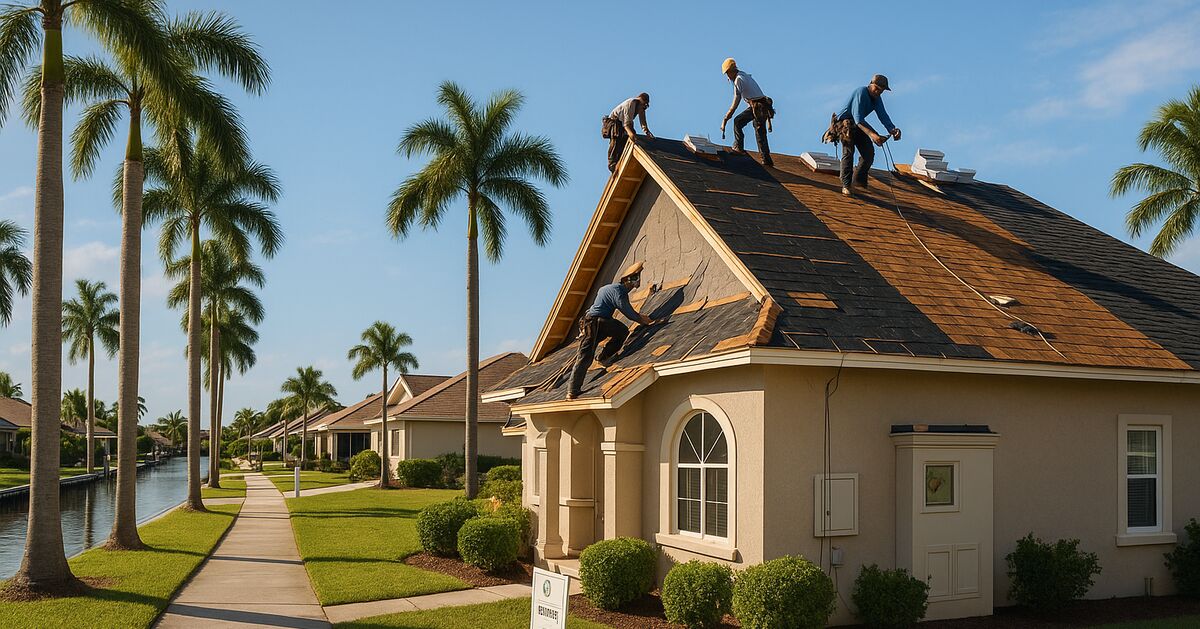
Your roof replacement paperwork is signed, your contractor is scheduled, and you're focused on picking the right material. Flood insurance is probably the last thing on your mind. But in Sarasota County and Charlotte County flood zones, a re-roofing project can quietly trigger a change in your NFIP or private flood insurance rating, and not knowing about it in advance can cost you hundreds of dollars a year or, in the worst case, a gap in coverage right when a tropical storm rolls through.
This post walks you through exactly how that connection works, what questions to ask your insurer before work starts, and what our crews see on the ground when we work in communities from Sarasota and Venice to Port Charlotte and Englewood.
Why your roof and your flood insurance are linked at all
At first glance, flooding comes from the ground up and roofs are about keeping water out from above. So why would a reroofing project touch your flood insurance?
The answer lies in how FEMA's National Flood Insurance Program (NFIP) defines a "substantial improvement." Under FEMA rules, if a renovation project costs 50 percent or more of the pre-improvement market value of a structure, the entire building must be brought into compliance with current floodplain management regulations. That can mean elevating the structure, which is a major and expensive undertaking.
A full roof replacement on a large home can easily run into the tens of thousands of dollars. On an older home with a modest assessed value, that number can creep toward or past that 50 percent threshold faster than most homeowners expect. In Sarasota and Charlotte County, local floodplain administrators at the county level track these cumulative improvements, meaning a roof job this year combined with a kitchen remodel two years ago could push you over the line even if neither project alone would have.
This is not a reason to avoid replacing your roof. A deteriorating roof is a far greater risk to your home than any paperwork issue. It is, however, a very good reason to make a phone call before work begins.
How the NFIP rating system actually works
The NFIP uses a rating method called Risk Rating 2.0, which FEMA rolled out in 2021. Under this system, individual properties are rated on a long list of factors: flood zone designation, distance to water, first-floor elevation relative to the Base Flood Elevation (BFE), foundation type, and the replacement cost of the structure itself.
That last factor matters for re-roofing. When your roof is replaced with a higher-quality material, say, from three-tab asphalt shingles to a standing-seam metal roof, your home's replacement cost value goes up. A higher replacement cost value can increase the NFIP premium, because the program is now insuring a more valuable structure. Conversely, replacing a severely deteriorated roof raises the home's actual condition and may affect how private flood insurers assess your risk profile.
Private flood insurers, which have grown significantly in Florida as an alternative to the NFIP, have their own underwriting models. Some of them look at roof age and condition as a proxy for overall home maintenance. A brand-new roof, especially one installed to current Florida Building Code wind standards, can actually work in your favor with some private carriers. Others are indifferent to it. You won't know unless you ask.
The "substantial improvement" trap and how to check your exposure
Here is a practical step-by-step approach for homeowners in FEMA Special Flood Hazard Areas (Zones A, AE, VE, and their variants) in Sarasota and Charlotte County.
- Get your home's pre-improvement market value in writing. This is typically the assessed value from the county property appraiser, not the sale price or the Zillow estimate. Sarasota County and Charlotte County both have online property appraiser portals where you can pull this number for free.
- Get a written cost estimate for the full roof replacement before work begins. Your contractor should be able to provide a detailed line-item estimate. This is also what you will need if the county asks for documentation.
- Contact the local floodplain administrator. In Sarasota County, this is handled through the Building Department. In Charlotte County, the same. Tell them you are planning a roof replacement and ask whether the project, combined with any improvements made in the past few years, will trigger the substantial improvement review. They are required to help you with this question, and there is no cost.
- Pull your Elevation Certificate if you have one. Your Elevation Certificate shows your first-floor elevation relative to the BFE. If a substantial improvement determination does come up, this document is central to understanding what compliance would require.
- Call your flood insurer before the permit is pulled. Not after. Once the permit is in the system, the county may flag it automatically.
Our team at Suncoast Roofing Pros works regularly in flood zones across the Suncoast and we can coordinate with your permit process. Our crews are also experienced with the coastal flood zone rules specific to Anna Maria Island, which layer additional complexity onto an already detailed process.
What a re-roof can do to your flood premium: the scenarios
Let's walk through the realistic scenarios you might face.
Scenario 1: You are in Zone X (minimal flood risk). Zone X properties are outside the Special Flood Hazard Area. The substantial improvement rules still exist on paper but are rarely triggered in practice for a standard re-roof. Your flood insurance, if you carry it voluntarily, is unlikely to change meaningfully because of the new roof alone.
Scenario 2: You are in Zone AE in an inland area of Sarasota or Lakewood Ranch. Zone AE is the most common flood zone designation for properties near ponds, canals, and inland waterways. The substantial improvement threshold applies. If your home is modest in value and you are doing a full replacement, the 50 percent check is worth doing. If you clear it comfortably, the main flood insurance consideration is the replacement cost value adjustment mentioned above.
Scenario 3: You are in a VE zone on or near the coast (think barrier islands near Siesta Key, Englewood Beach, or the Nokomis and Osprey coastlines). VE zones carry the highest regulatory burden. These are coastal high-hazard areas where wave action is factored into flood risk. Substantial improvement rules are enforced carefully here, and any structure that crosses the threshold must meet current freeboard and construction standards. A re-roof alone may not cross the threshold, but if you are also doing soffit replacement, fascia work, or structural deck repairs, costs add up.
Scenario 4: You switch from shingles to metal on an older home in Port Charlotte. Port Charlotte has a large inventory of homes built in the 1970s and 1980s with modest assessed values. A premium metal re-roof on one of these homes can represent a significant percentage of the structure's value. This is one of the more common situations where we recommend a pre-project call to the Charlotte County floodplain office. For more on how Citizens Insurance rules intersect with roof age in this area, the post on Florida's Citizens Insurance roof age rule and Port Charlotte homeowners covers the wind insurance side of the equation.
Questions to ask your insurer before work starts
Write these down and call your flood insurer directly. Do not rely on your general insurance agent to have flood-specific answers unless they specialize in it. If you carry NFIP coverage, your Write-Your-Own (WYO) carrier may refer you back to FEMA resources for technical questions.
- Will replacing my roof change my building's replacement cost value for rating purposes, and by how much?
- Do you require notification when I complete a structural improvement, and what is the deadline for that notice?
- Will a new roof affect my policy's coverage limit, or does the limit need to be adjusted separately?
- If I am in a VE or AE zone, does your underwriting model treat a new roof as a material change requiring re-rating?
- If I switch materials (for example, from shingles to metal), does that change my risk classification?
- Does my policy lapse or go into a grace period during active construction? Some policies have exclusions or reduced coverage while the structure is under active renovation. You want to know this before the old roof is torn off, especially during storm season.
- Does completing a roof to current Florida Building Code wind standards affect my flood premium indirectly? Some private carriers use wind mitigation compliance as a general home quality signal.
Flood insurance policies, unlike homeowners policies, typically do not have automatic re-rating triggers for mid-term improvements. But when your policy renews, you may be re-rated based on updated information in FEMA's systems or your insurer's own data. Knowing what is coming helps you budget.
How permit documentation protects you
One thing we see homeowners overlook is the value of keeping complete permit records from a roofing project. In Sarasota and Charlotte counties, the permit record becomes part of the property's documented improvement history. If you ever need to dispute a substantial improvement determination in the future, having clear documentation that your roof replacement was permitted, inspected, and closed out properly is essential.
Our work in Bradenton and Nokomis follows the same principle: every project we complete gets properly permitted and inspected. Beyond the legal requirement, it protects you at resale, during insurance claims, and in exactly this kind of regulatory review.
For a deeper look at what happens when contractor documentation goes wrong, the post on roof warranties when a Florida contractor goes out of business mid-project is worth reading before you sign any contract.
Timing your project relative to flood season
In Southwest Florida, hurricane season runs June through November and flood season tracks closely with it. If you are in a flood zone, you want your new roof completed, inspected, and your insurance records updated before the active part of the season.
Starting a re-roof in September or October in an AE or VE zone means you could be in the middle of a tear-off during a named storm. Most policies exclude coverage for an open structure. Plan your project for late winter or spring if at all possible. We are typically heavily booked from January through April, so getting on the schedule early matters. Communities like Lakewood Ranch have seen longer lead times due to construction demand, something our post on what the Lakewood Ranch construction boom means for your replacement timeline covers in detail.
A note on elevation certificates and roof-related claims
If you do not have an Elevation Certificate for your property and you are in a Special Flood Hazard Area, getting one before a re-roof can be useful for a different reason. Your first-floor elevation relative to the BFE is a primary driver of your NFIP premium. If your home is elevated above the BFE and the certificate on file with your insurer is old or missing, you may be paying more than you should. A re-roof project is a natural moment to get that certificate updated, because your contractor and a licensed surveyor may already be working around the property.
This is especially relevant in older coastal communities from Englewood up through Osprey, where elevation certificates from the 1980s and 1990s may not reflect current FEMA maps.
The bottom line
A roof replacement is one of the largest investments you will make in your home. In Sarasota and Charlotte County flood zones, it intersects with a regulatory and insurance framework that most homeowners are not aware of until something catches them by surprise. The good news is that the process is manageable with a little preparation.
Call your flood insurer. Call the county floodplain office. Get your cost estimates and your market value number in writing before work begins. And choose a contractor who understands the local permit environment and can give you documentation you can actually use.
You can learn more about our work across the Suncoast on our locations page, or get in touch to talk through your project before you commit to a schedule. The conversation costs nothing, and knowing what you're walking into is worth a lot.